1,645 total reads
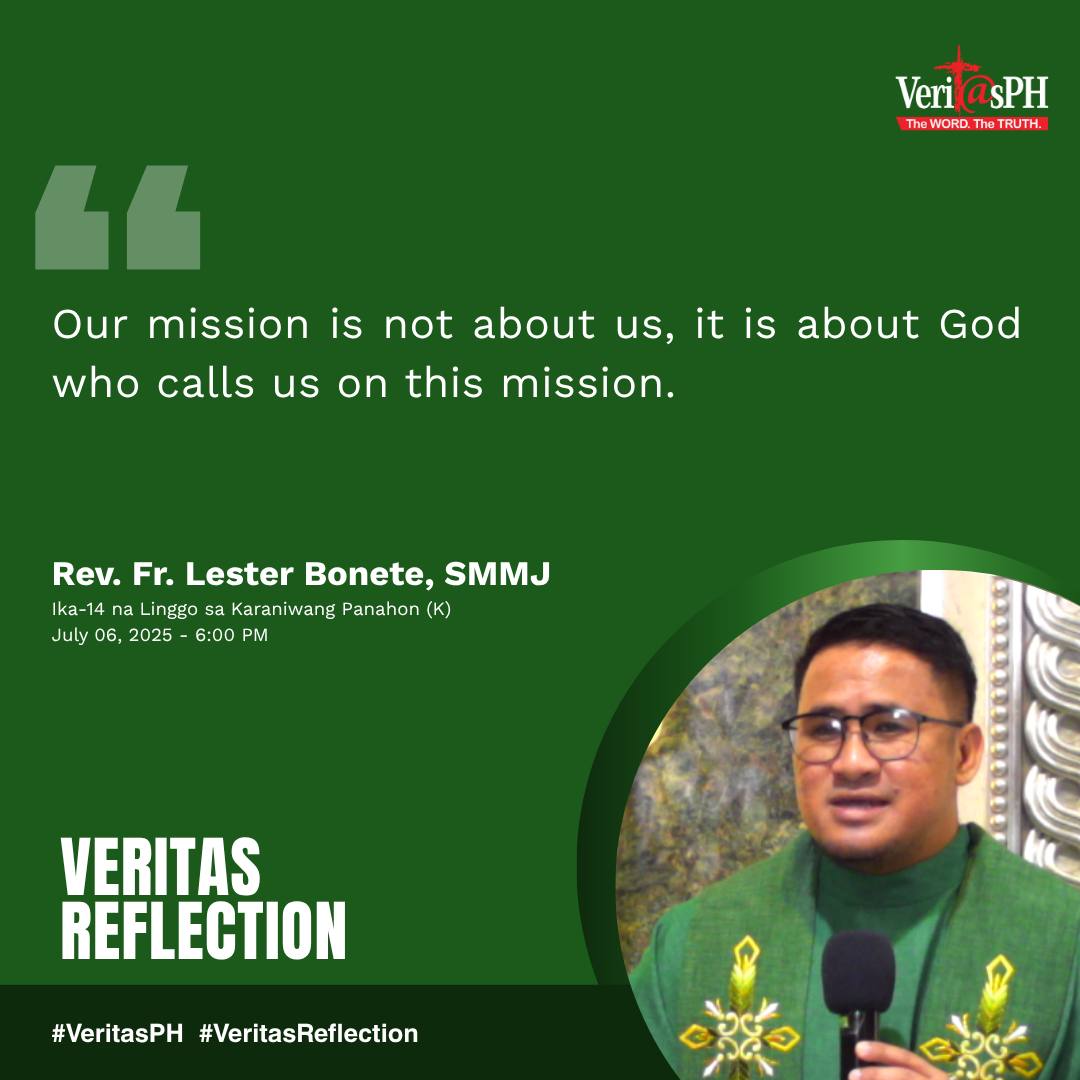
#VERITASREFLECTION: “Our mission is not about us, it is about God who calls us on this mission.”
– Rev. Fr.Lester Bonete, SMM
Ika-14 na Linggo sa Karaniwang Panahon (K)
July 06, 2025 – 6:00 PM


9,031 total reads
Gospel Reading for October 05, 2026 – Luke 10: 25-37
The ROADMAP
There was a scholar of the law who stood up to test Jesus and said, “Teacher, what must I do to inherit eternal life?” Jesus said to him, “What is written in the law? How do you read it?” He said in reply, “You shall love the Lord, your God, with all your heart, with all your being, with all your strength, and with all your mind, and your neighbor as yourself.”
He replied to him, “You have answered correctly; do this and you will live.” But because he wished to justify himself, he said to Jesus, “And who is my neighbor?”
Jesus replied, “A man fell victim to robbers as he went down from Jerusalem to Jericho. They stripped and beat him and went off leaving him half-dead. A priest happened to be going down that road, but when he saw him, he passed by on the opposite side. Likewise a Levite came to the place, and when he saw him, he passed by on the opposite side. But a Samaritan traveler who came upon him was moved with compassion at the sight. He approached the victim, poured oil and wine over his wounds and bandaged them. Then he lifted him up on his own animal, took him to an inn, and cared for him. The next day he took out two silver coins and gave them to the innkeeper with the instruction, ‘Take care of him. If you spend more than what I have given you, I shall repay you on my way back.’
Which of these three, in your opinion, was neighbor to the robbers’ victim?” He answered,“The one who treated him with mercy.” Jesus said to him, “Go and do likewise.”
————
Jesus was indeed a GREAT STORYTELLER. Most of the time, when people asked him about something, he would respond with a story. When he wanted to teach something, he spoke in parables.
He is the Son of God. He said, “I and the Father are one” (John 10:30). This means that this is the style of the Father.
It would be so easy to just give the answer or teach a lesson directly, but this is our God—who gave us an intellect and a soul so that we ourselves may find the answers we seek in life, especially in the spiritual realm. This is the Word of God. It is not meant to be taught like a lesson in class. It is meant to be listened to with all ears and kept in our hearts with deep sincerity.
The Word of God is SO PRECIOUS because it is the way of life of all who believe in God. It is SO PRECIOUS because we do not have to go through life wasting time on trial and error. It is SO PRECIOUS because it is The ROADMAP going to heaven.
Lord Jesus, thank you for leading us to the Father!

9,461 total reads
27th Sunday A
Is 5:1-7
The reading is a poetic song using metaphor to depict covenant infidelity, with the vineyard symbolizing Israel and Yahweh. The prophet narrates the careful construction of the vineyard, expecting a good harvest, but results in bitter disappointment. Judah is called to judge itself, with the vineyard’s dismantling representing Israel’s loss of protection and proper cultivation. The parable ends with judgment and violence, highlighting God’s desire for fidelity and justice, especially for the poor, but finding only selfishness and treachery, leading to destruction and exile.
Phil 4:6-9
In the final part of this letter, Paul urges the community to set aside worries and turn to prayer (v6). God’s peace, which surpasses understanding (v7), results from harmonious relations with God and others, found when one commits to Christ (Col 3:15). He also recommends Stoic virtues (v8) that celebrate human values connected to the God of peace. Life’s goodness includes natural beauty, human achievements, and spiritual uplift.
Mt 21:33-43
The gospel describes the parable of the vineyard from Isaiah 5, representing Israel as the vineyard and Yahweh as its owner. The parable evolved in early church history but reflects Jesus’ ministry of rejection and replacement. The chief priests and the Pharisees are the tenants whose responsibility is to produce the fruit the owner’s servants are sent to collect. The two sets of servants are the prophets: they are rejected, abused, even killed, (vv34-36 cf Jer 20:2; 26:21-23; and were often referred to by Jesus, 5:12; 22:6; 23:30-37). The son, the final emissary, is Jesus himself, with an allusion to his death outside of Jerusalem (vv38-39; Jn 19:17; Heb 13:12f).
The Jewish leaders pass sentence on themselves. Psalm 118 was used in the early church as a prophecy of Jesus’ rejection and victory.
The term “karpos” ( καρπὸς ) is constantly used in the Bible. But aside from its literal meaning of fruit, grain, or harvest; or in the sense of “offspring” (Lk 1.42) or “descendant” (Acts 2.30), the kind of fruit expected by the owner of the vineyard refers metaphorially to the duty Israel owes to God (cf. Isa 5:4), to a godly lifestyle which is consistent with a rightly-ordered covenant relationship with God. The Matthean ideal of ” bearing fruit” connotes the sense of “moral characteristics”: repentance (3:8,10); good deeds (7:16-20; 12:33); and fruitfulness (13:8; 21:19). In this regard the religious leaders of his time failed to teach such, nurture spiritual growth and fruitfulness among the people, and inspire covenant fidelity, for they themselves live an unrepentant and duplicity of life. Thus responsibility over the vineyard will be transferred to the faithful ones as promised in Isa 55:3-5. (vv43, 45).
Isaiah’s song and Matthew’s parable of the vineyard conclude in much the same way—on a note of disillusionment. Whether the present-day ‘tenants of the vineyard of the Lord’ produce fruit or not, we nevertheless remain God’s vineyard, which He continually cultivates. Fidelity to God’s will produces an abundant harvest. Are we producing fruits of “whatever is true, honorable, just, pure, lovely, gracious…excellence, worthy of praise” (cf. Phil. 4:6-9)? May it be so. Amen.
10,016 total reads
Gospel Reading for October 04, 2026 – Matthew 21: 33-43
CHANCE TO REALIGN
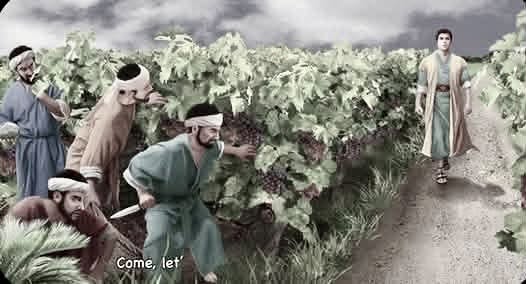
Jesus said to the chief priests and the elders of the people: “Hear another parable. There was a landowner who planted a vineyard, put a hedge around it, dug a wine press in it, and built a tower. Then he leased it to tenants and went on a journey. When vintage time drew near, he sent his servants to the tenants to obtain his produce. But the tenants seized the servants and one they beat, another they killed, and a third they stoned. Again he sent other servants, more numerous than the first ones, but they treated them in the same way. Finally, he sent his son to them, thinking, ‘They will respect my son.’ But when the tenants saw the son, they said to one another, ‘This is the heir. Come, let us kill him and acquire his inheritance.’ They seized him, threw him out of the vineyard, and killed him. What will the owner of the vineyard do to those tenants when he comes?” They answered him, “He will put those wretched men to a wretched death and lease his vineyard to other tenants who will give him the produce at the proper times.” Jesus said to them, “Did you never read in the Scriptures:
The stone that the builders rejected
has become the cornerstone;
by the Lord has this been done,
and it is wonderful in our eyes?
Therefore, I say to you, the kingdom of God will be taken away from you and given to a people that will produce its fruit.”
————
“He will put those wretched men to a wretched death and lease his vineyard to other tenants who will give him the produce at the proper times.”
It was so easy for the chief priests and elders to answer what had to be done to the wicked tenants because they did not think of themselves as the tenants.
However, what Jesus said next made them realize that they were the tenants in Jesus’ parable. They wanted to arrest him, but they were afraid of the people who looked up to him as a prophet.
This proves that the Word of God is indeed as Hebrews 4:12 states: “The Word of God is living, active, and sharper than any double-edged sword, able to penetrate deep within us and judge our thoughts and motives.”
It is not meant to make us feel bad about ourselves, but to give us the CHANCE TO REALIGN with the person made in God’s image and likeness. It is the only way Christians can live a truly joyful, peaceful, and fruitful life in this world, in the midst of challenges and difficulties.
Speak, Lord, we are listening!

34,456 total reads
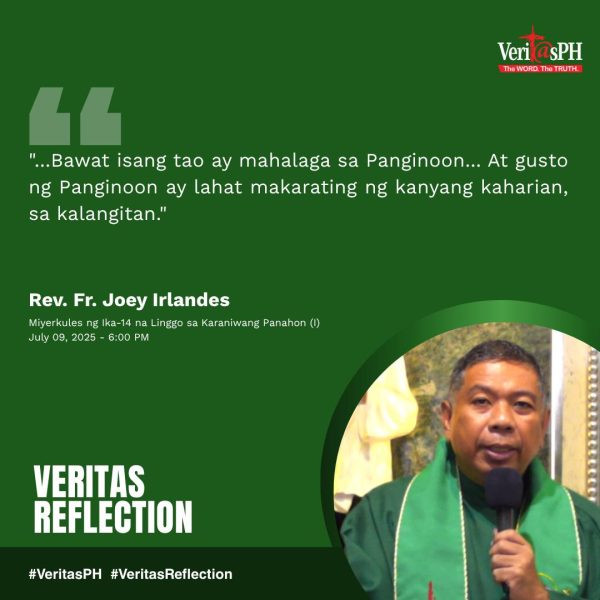
34,456 total reads #VERITASREFLECTION: “…Bawat isang tao ay mahalaga sa Panginoon… At gusto ng Panginoon ay lahat makarating ng kanyang kaharian, sa kalangitan.”-Rev. Fr. Joey IrlandesMiyerkules
34,457 total reads
34,457 total reads #VERITASREFLECTION: “Gaya ng pagmamahal ng Panginoon sa makakasalanan, nawa ay ating isabuhay ang magpatawad sa mga taong nagkakasala rin sa atin. Bigyan natin
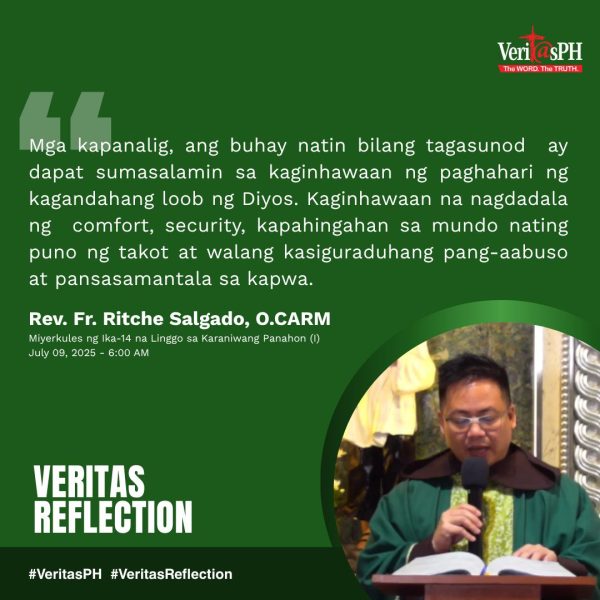
34,458 total reads
34,458 total reads #VERITASREFLECTION: “Ang ating buhay ay dapat sumasalamin sa kadakilaan at kababaang loob ng Panginoon.”– Rev. Fr. Ritche Salgado, O.CARMMiyerkules ng Ika-14 na Linggo
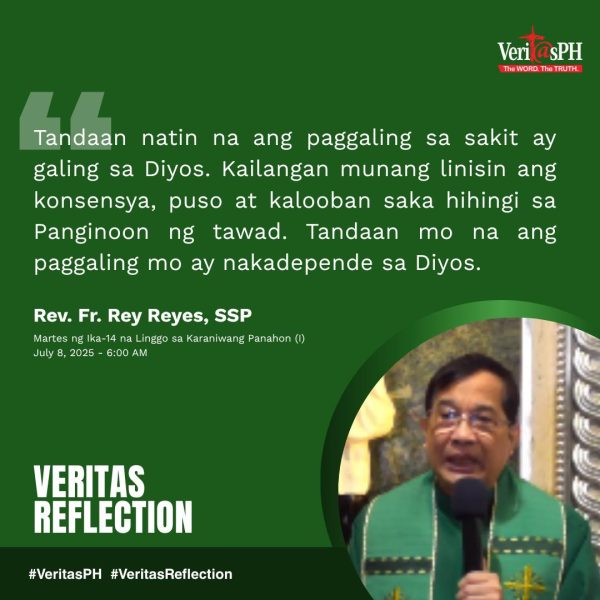
34,458 total reads
34,458 total reads #VERITASREFLECTION: “Samahan natin ng malalim na pananampalataya ang ating hiling na makalaya sa ating mga sakit dahil walang imposible sa Diyos at kayang-kaya
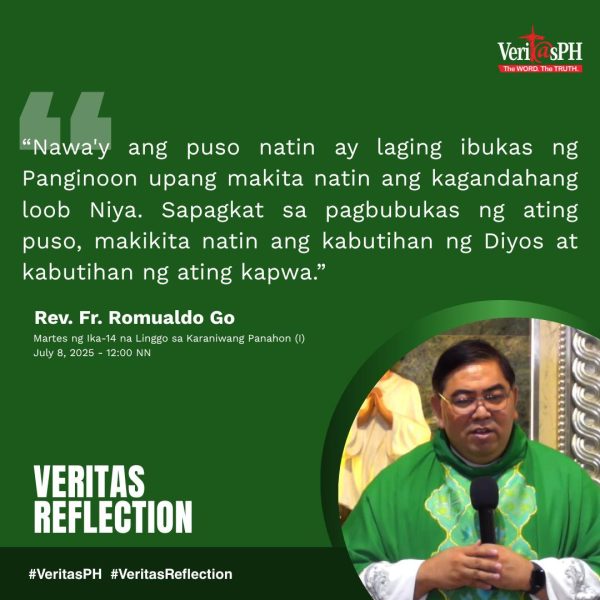
34,457 total reads
34,457 total reads #VERITASREFLECTION: “Nawa’y ang puso natin ay laging ibukas ng Panginoon upang makita natin ang kagandahang loob Niya. Sapagkat sa pagbubukas ng ating puso,