

12,146 total reads
The symbolism of bread emerges prominently in the readings for the Year C celebration of the feast of Corpus Christi. Melchizedek, a king and priest, makes a brief appearance in Genesis (14:18-20) as the one who blessed Abram. Although the scriptures provide no further commentary on his offering of bread and wine, church tradition has long interpreted this gesture as significant.
The New Testament draws additional parallels between Melchizedek and Christ, (cf Heb 7 interpreting Melchizedek as a prefiguration of Christ) particularly noting that he served as a priest outside of the Levitical line. In today’s second reading, Paul refers to the liturgy of his time, recounting how Jesus imbued bread and wine with new meaning, transforming them into a memorial of his death (1 Cor 11:23 – 26).
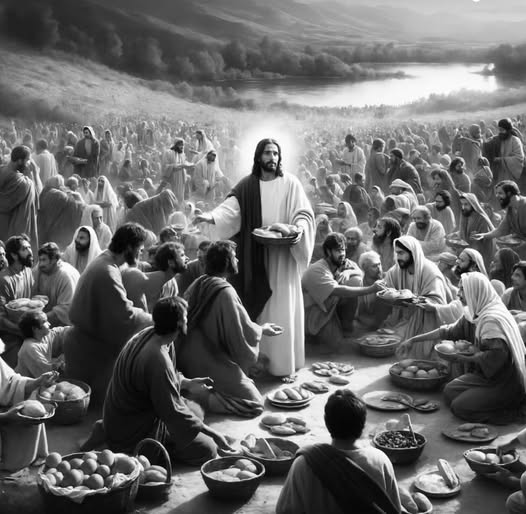
In the Lucan gospel (9:11-17) Jesus’ act of providing bread for the crowd is understood as symbolic of the Eucharist. “Although there is mention of both loaves and fish, it is the bread that is, predominant even to the collection of the “fragments”, klasmata, (κλασμάτα) v17. This term became the technical expression for the Eucharistic bread. Thus the “breaking of the bread” is used before it is referred to as the Eucharist, (cf Acts 2:46). The action of Jesus in ‘taking, blessing, breaking, and giving’ (v16), reproduces the almost exactly the last supper formula (22:19), and the Emmaus meal (24:230). In the church Jesus continues to feed and nourish his followers through the ministry of the apostles (it was the apostles who distributed them, v16), and eventually their successors in the sacramental celebration of his saving death”, (cf s1S#90 Fragments; 06/19/22).
By partaking in the Body and Blood of Christ, we share in the New Passover of Christ. We pass over from sin to grace, from death to life. As we celebrate this feast of the wonderful sacrament he left us as a memorial of his passion, let us continue to receive him worthily that we may experience the fruits of his redemption and be nourished by the bread that gives eternal life and be able to make his presence be felt through our own self-giving for others.
And let us pray:
“Soul of Christ, sanctify me.
Body of Christ, save me.
Blood of Christ, inebriate me.
Water from the side of Christ, wash me. Passion of Christ, strengthen me…Amen.”
s1S#193 Eucharist (5/31/24)
The word Eucharist is the direct translation of the noun ‘eucharistia’ ( εὐχαριστία ) and is primarily an expression of gratitude to God (especially in the letters of St. Paul, e.g. 2Cor 4:15, 9:11,12), and in particular as thanksgiving to God in worship, (cf 1Cor 14:16; Rev 4:9,7:2). But what could allude to the Eucharist as celebrated today is the verbal form of the word (‘eucharisteō’) found in the narrative of the institution of the Eucharist: 1 Cor 11:23-25; Mt 26: 26-29; Mk 14: 22-25; Lk 22:17-20, where Jesus “gave thanks”. John is silent about the institution but his discourse on the Bread of Life in Chapter 6, especially vv. 51-58 is clearly Eucharistic.
Jesus chose the precise time of the Passover, (the feast when the Jews remember the saving acts of God and thank him for his gratuitous covenant with them as his people), to institute the Holy Eucharist. At the Last Supper, he took bread and wine, declaring them his Body and Blood, and anticipated his death on the Cross, his passing over to the Father. It is the New Passover. Other vocabularies in the institution spoken by Jesus confirmed it- ‘broken’, ‘body given’, ‘blood poured out or shed for’, ‘the remission of sins’. Jesus is indeed the high priest and mediator of the new covenant who by his own blood performed the rite of purification and given us access to God, (cf. Heb 9:11-15; cf s1S#34 Thanks, 06/06/21).