

16,503 total reads
3rd Sunday Easter (A)
Acts 2:14, 22-28
This is one of six key speeches in Acts where Peter proclaims Jesus as the Messiah to his Jewish audience. These speeches, likely independent early church sermons, share common features but are uniquely shaped by Luke in style and content, forming part of Luke-Acts. Peter, speaking with the eleven, represents Israel, addressing opponents as faithful Israel speaking to its enemies. The main points include the kerygma—centered on Christ’s death and resurrection; God’s plan, emphasizing Jesus’ divine foreknowledge rather than human manipulation; extensive scriptural support, especially Psalm 16, illustrating Jesus’ resurrection; and the Jews’ guilt, mainly the Jewish leaders’, for Jesus’ death, although God’s plan prevails. The speeches highlight that Jesus’ passage was foretold, with early signs of opponents’ conversion.
1 Pet 1:17 – 21
The reading discusses how the Christian conduct during a pagan sojourn is based on respect for God, who is both Father and Judge. Jesus’ action as a ransom, achieved through his atoning death and symbolized by the Lamb’s blood, signifies redemption from pagan alienation to a life with God. The reference to the Passover lamb foreshadows Christ, the “mystery of God,’ revealed in these final times. Praise is directed through Christ to the Father, with faith and hope inseparably linked; hope of future glory rooted in faith. Petrine and Pauline teachings emphasize upright conduct rooted in redemptive theology, making correct living a grateful response, not just ethics.
Lk 24:13-35
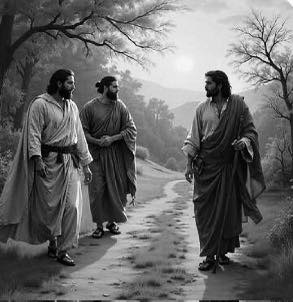
The gospel recounts the story of two disciples on the road to Emmaus, highlighting key theological themes. The transformed risen Christ is not immediately recognized, emphasizing his transcendent life. The disciples initially struggle with belief, contrasting with the women who believed quickly. The early church’s core belief, the kerygma, includes Jesus’ ministry, death, and resurrection, often supported by scriptures, which the disciples later see as confirming Jesus’ divine role. Luke underscores charity’s importance, as shown when the disciples invite Jesus to stay. The meal shared recalls eschatological and eucharistic themes, symbolizing unity, love, and faith. Through scripture, breaking bread, and generosity, the disciples become witnesses to the resurrection, eventually preaching a Christ recognized through faith and scriptural sharing.
Christ’s resurrection inaugurates new life, and He remains with us throughout our journey. Today’s reading from 1 Peter highlights the price paid for our freedom and our responsibility to act. The disciples’ words, ‘Stay with us,’ marked a faith transformation from disappointment to enthusiasm, a journey that mirrors our own as Christians. As the Second Vatican Council teaches, we meet Christ in the scriptures, which serve as a sacramental sign. We must ask if we are attentive to His word and participate fully in the Eucharist, which deepens our faith. Emmaus reminds us that Christ surrounds us and stays with us in generosity and concern. Our response should be one of gratitude and giving—hosting others, showing kindness, and supporting those in need. Let us pray, ‘Stay with us, Lord.’ Amen!