Rev. Msgr. Wilfredo Andrey
Sunday, August 23, 2026 7:30 am
747 total reads
21st Sunday A
Is 22:15, 19 – 23
This passage discusses the biblical account during King Hezekiah’s reign, focusing on Shebna, the king’s chief administrator, who is to be replaced for misconduct with Eliakim, the master of the palace. Shebna, identified as a scribe and palace official, retains a high administrative role even after his disgrace. Evidence suggests ‘master of the palace’ was a later addition to 22:15, with the original describing an unnamed official. Eliakim’s investiture symbolizes authority—holding the ‘key of the house of David,’ granting access to the king’s courts and privileges—thus firmly establishing his role in government.
Romans 11:33-36
The reading highlights God’s infinite wisdom and goodness. Paul concludes with a hymn praising God’s unmatched knowledge, which guides history and creation without need of counsel. His argument relies on two scriptural texts, one from Isaiah and an uncertain one, likely related to Job. The passage emphasizes giving glory to God, the origin, support, and ultimate goal of all, who directs history according to His plan, as seen in the Jew-Gentile discussion.
Mt 16:13-20
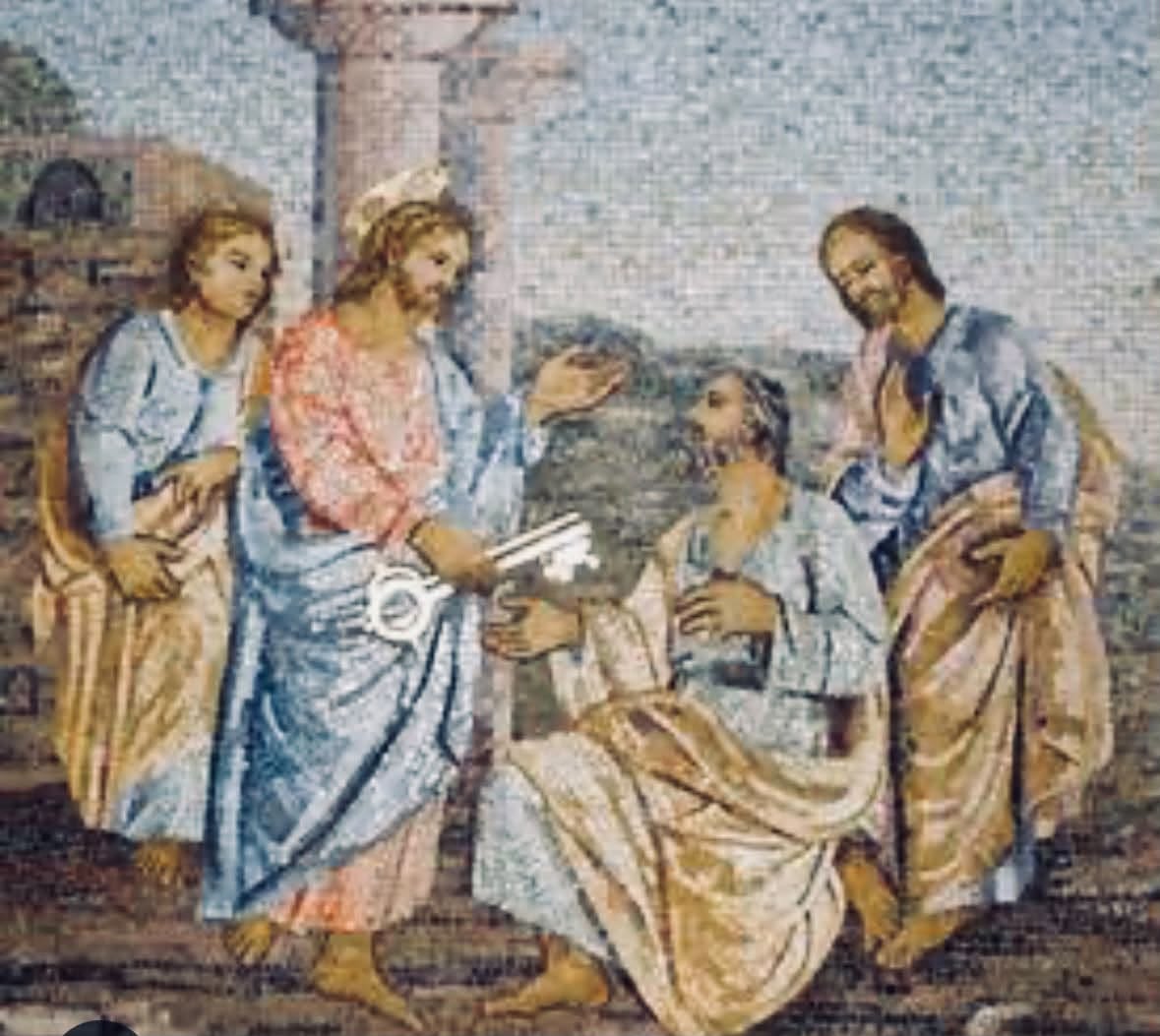
The gospel highlights a key church moment, showing Jesus’ recognition of Peter as the foundational leader, symbolized by the renaming as Rock and given authority to bind and loose. This passage, unique to Matthew, emphasizes the church’s organized structure, authority, and divine guidance, rooted in Peter’s faith and revelation from God.
Peter’s authority is symbolized by the key Jesus gave him. The term “ kleis “ ( κλλείς ) occurs six times in NT and refers to “key” only in a metaphorical sense, but with powerful symbolism in each context. In Mt 16:19, Jesus promises to give Peter the “keys” of the kingdom as a sign of his apostolic authority. In Lk 11:52, the kleis refers to the “key” of knowledge which the Israelite lawyers had removed and deprived many people of the opportunity to enter into the kingdom of heaven. The supreme spiritual authority of Jesus the Messiah-King is indicated by the risen Christ holding the “keys” to death and Hades (Rev. 1:18), and the “key of David” (Rev 3:7). In Rev. 9:1; 20:1, kleis refers to the “key” of the bottomless pit as one of the symbols for the place of eternal punishment.
The image of the keys is probably drawn from Isaiah 22 (cf first reading) where Eliakim, who succeeds Shebnah as master of the palace, is given”the key of the house of David,” which he “opens and “shuts” authoritatively. There are many instances in rabbinic literature of the binding-loosing imagery. Of the several meanings given there to the metaphor, two are of special importance here: the giving of authoritative teaching, and the lifting or imposing of the ban of excommunication.
Today we are reminded that as the head of the Church, Peter and the Popes hold a special place, especially when it comes to teaching us and guiding us about matters of faith and morality. Let us pray for Pope Leo XIV and other Church leaders so that they remain steadfast in the ministry entrusted to them by Christ, and that we all stay loyal to the Church even when it is continually rocked by scandals that erode her credibility. Amen.
Most Rev. Broderick Pabillo, D.D.
Sunday, August 23, 2026 7:00 am
927 total reads
21st Sunday in Ordinary Time Cycle A
Is 22:19-23 Rom 11:33-36 Mt 16:13-20
Nauuso ngayon ang paggawa ng mga survey upang malaman ang palagay ng mga tao. Ginagamit ito sa pulitika, sa business at sa maraming pag-aaral. Sa panahon ng election maraming survey ang ginagawa kung sino ba ang iboboto ng mga tao. Ok lang na gawin ito pero sana naman makatotohanan ang mga survey kasi maaaring mangyari na minamanipula ang resulta ayon sa kagustuhan ng nagpapasurvey. Pero isa din na dapat nating alalahanin, na ang katotohanan ay hindi nanggagaling sa survey. Kahit na ang karamihan ay nagsasabi ng isang bagay, kung iyan ay masama, hindi iyan nagiging mabuti dahil sa iyan ay pinaniniwalaan ng mga tao. Ang kasinungalingan ay hindi nagiging totoo kasi iyan ang paniniwala ng nakararami. Ang pagpatay ay mali kahit na sinasang-ayunan ng karamihan. Kaya ang abortion ay masama kahit na sinasabi ng ibang bansa na ito ay bahagi ng reproductive health. Paano naging pangkalusugan ang pagpatay ng bata? Ang salitang “reproductive health” ay isa sa mga panlilinlang ngayon. Ang pagpapalaglag ng bata ay ang kalagayan na walang reproduction at walang health! Kaya mag-ingat po tayo kasi may mga nagpapahiwatig na nagiging tama ang isang bagay kasi sinasabi ng survey.
Si Jesus ay nagsurvey din. Matagal-tagal na siyang nangangaral. Marami na siyang napagaling. Marami na ang sumusunod sa kanya. Sino kaya siya ayon sa mga tao? Ano ba ang palagay ng mga tao sa kanya? Kaya tinanong niya ang mga alagad niya: “Sino raw ako ayon sa mga tao?” Iba-iba ang sinasabi ng mga tao. “Ikaw daw ay si Juan Bautista na muling nabuhay. Ikaw daw ay si propeta Elias na darating. Ikaw daw ay si propeta Jeremias o isa sa mga propeta na bumalik uli.” Nagkaisa sila na si Jesus ay isang propeta, pero hindi nagkasundo kung sinong propeta.
Pero ang mahalaga kay Jesus ay hindi kung ano ang tingin ng mga tao sa kanya. Ang mahalaga sa kanya ay kung ano ang tingin natin sa kanya. Kaya ang tanong niya: “Kayo naman, ano ang sabi ninyo? Sino ako?” Siguro napatigil silang lahat. Baka sila rin ay iba-iba ang pagkakilala nila kay Jesus. Ang nangahas na magsalita ay si Simon. Tumpak ang sagot niya: “Kayo po ang Kristo, ang Anak ng Diyos na Buhay.” Tama ang sagot ni Simon hindi dahil sa mas magaling siya kaysa iba o mas matalino siya. Tumpak ang sagot niya kasi ipinakilala sa kanya ng Diyos Ama kung sino talaga si Jesus. Ang tunay na pagkilala kay Jesus ay hindi nanggagaling sa majority opinion o sa katalinuhan ng tao. Ito ay regalo ng Diyos. Ipinakikilala ng Diyos Ama ang Diyos Anak at dinadala ng Diyos Anak ang tao sa Diyos Ama. Iyan ay sa pamamagitan ng Espiritu Santo na siya ang Espiritu ng Katotohanan. Dahil sa pinili ng Diyos Ama si Simon, kaya pinili din siya ni Jesus. Pinalitan ni Jesus ang kanyang pangalan. Hindi na siya si Simon kundi si Pedro na siya. Ang salitang Pedro ay nangangahulugan na bato. Si Bato na siya sapagkat sa batong ito itatayo ni Jesus ng kanyang simbahan. Matatag ang simbahan kasi ito ay nakatayo sa matatag na pananampalataya ni Pedro. Kahit na hampasin man ito ng malakas na hangin, ng alon, o ng baha mananatili itong nakatayo. Ni hindi ito masisira ng pag-aatake ng kapangyarihan ng kasamaan. Napatunayan na ito sa kasaysayan. Marami nang mga hari at generals ang umatake dito, nakatayo pa rin ang simbahan. May guarantee na binigay si Jesus. Garantisado ang simbahan.
Hindi lang ito iniingatan ni Jesus. Binigyan pa rin ng kapangyarihan si Pedro na magbigay ng wastong pagpapasya at katuruan sa simbahan. Ibinigay kay Pedro at sa kanyang mga kahalili ang kapangyarihan na mag-discern kung ano ang tama at ano ang mali. Kaya kung ano ang idiklara niyang tama dito sa lupa ay tama nga, pati na sa langit. Ano ang ipagbabawal niya sa lupa kasi ito ay mali, ang talagang mali pati na sa langit. Iyan ang kapangyarihan ng susi. Ang may hawak ng susi ay may kapangyarihan na magpapasok o magpabawal.
Sa ating unang pagbasa kinuha kay Sabna ang susi sa palasyo ng hari sa Jerusalem. Tinanggal siya sa pagiging katiwala ng kaharian kasi naging mayabang siya. Ganoon siya kayabang na gusto niyang kilalanin siya kahit na patay na siya. Nagpapagawa na siya ng magarang libingan sa Jerusalem. Ibinigay ang susi, ang katungkulan na magiging katiwala, kay Eliaquim. Ibinigay sa kanya ang susi ng palasyo ni David. Walang makasasara sa bubuksan niya at walang makabubukas sa pinagsarhan niya. Siya na ang may kapangyarihan ng susi.
Sa ating ikalawang pagbasa nabanggit ni Pablo: “Hindi matarok ang kayamanan, karunungan at kaalaman ng Diyos! Hindi malirip ang kanyang mga panukala at pamamaraan. Mula sa kanya ang lahat ng bagay.” Pero sa kanyang kagandahang loob pinapaabot ng Diyos ang kanyang kalooban sa mga tao sa pamamagitan ng mga kahalili ni Pedro, ang mga santo papa. Ayaw ng Diyos na magkamali tayo sa pinakamahalagang kaalaman – ang daan patungong langit. Kung magkamali tayo tungkol sa business decisions natin, mawawalan tayo ng pera pero maaaring mabawi uli ito. Kung magkamali tayo sa ating kaibigan, maaari uling makipagkasundo. Pero kung maging mali ang daan natin sa kaligtasan, baka hindi na natin ito mabawi. Kaya sinisigurado ng Diyos na maging tama ang ating pagkilala sa kanya at ang tungkol sa mabuti. Binibigyan niya tayo ng maaasahang gabay.
Oo, nandiyan na ang Banal na Kasulatan. Dito matatagpuan ang Salita ng Diyos na isinulat sa gabay ng Espiritu Santo. Nakakasigurado tayo na ang nakasulat doon ay tama. Ginabayan ng Espiritu Santo ang mga manunulat ng Bible. Tama nga ang nakasulat, pero tama ba ang pag-unawa natin dito? Hindi naman nagsasalita ang Bible kung mali ang ating pag-unawa dito. Kaya tulad ng ang Espiritu Santo ay kumilos sa pagsulat ng Bibliya, ang Espiritu Santo ay kumikilos din sa simbahan na gumagabay sa atin sa wastong pag-unawa sa nakasulat sa Bible. Ang simbahang ito, ang simbahang katoliko, ay ginagabayan ng Santo Papa tungkol sa wastong pag-unawa. Siya ang may susi sa langit. Ang kanyang pahihintulutan sa lupa ay pahihintulutan sa langit. Magpasalamat tayo sa Diyos sa pagbibigay sa atin ng wastong pananampalataya.
Kailangan natin ang bato ng pananampalataya ni Pedro sa ating panahon ngayon na maraming mga katuruan ay nagdadala sa atin sa kasamaan. Nandiyan ang Gender Ideology. Sa halip na tanggapin ang bigay sa kanila na kasarian ng Diyos na manlilikha at magpagmahal, karapatan daw ng bawat isa na pumili ng kanyang kasarian, ng kanyang gender. Hinihiwalay ang biological sex sa gender na gusto nila. Lalaki ang kanyang katawan pero gustong ituring siyang babae, at nagpapaopera pa nga para magmukhang babae. Sa halip na kilalanin na ang buhay ay biyaya na bigay ng Diyos na dapat pangalagaan, sinasabi ng ilan na sila ang may-ari ng kanilang buhay, kaya may karapatan silang magpakamatay. Sa halip na kilalanin na ang kayamanan ng mundo ay para sa lahat at dapat pakinabangan ng lahat, inaangkin ng iilan tao lamang ang kayamanan ng mundo kaya sa Pilipinas ang limampung pinakamayaman na Pilipino ay mas mayaman pa kaysa 60 milyong mga Pilipino. Kaya marami ang namamatay sa gutom pero may ilan na kumakain ng sopas na nagkakahalaga ng ten thousand pesos! Maraming mga pananaw sa mundo ngayon na hindi na naaayon sa plano ng Diyos. Kailangan natin ng gagabay sa atin para sa katotohanan. Kailangan tayong makinig sa binigay ng Diyos na maaasahang gabay – ang bibliya, ang simbahan at ang Santo Papa na kahalili ni Pedro, ang bato na kinatatayuan ng katotohanan.
H.E. Pablo Virgilio Cardinal David, D.D.
Saturday, August 22, 2026 4:14 pm
2,919 total reads
Homily for the Last Day of the Novena Mass of Mary the Queen Parish, Friday, 21 August 2026
Ezekiel 37:1–14; Matthew 22:34–40, Votive Mass of the Blessed Virgin Mary
Why is Jesus giving two answers to one question in our Gospel reading? He could have stopped after saying, “You shall love the Lord your God with all your heart, with all your soul, and with all your mind.” That answer would have been enough. After all, the question was simply, “Which is the greatest of all the commandments?”
The standard answer was the so-called Great Shema. It comes from Deuteronomy 6. Up until now, every young Jewish male who reaches the age of thirteen and celebrates his Bar Mitzvah is expected to know this Great Commandment by heart.
But Jesus added an unsolicited second answer. And he even qualified it as being of the same value as the first: “The second is like it.” Meaning, not only should it be treated as being of the same value; it should never be separated from the first: “You shall love your neighbor as yourself.” That comes from Leviticus 19:18.
The late Jaime Cardinal Sin used to refer to these “two loves” as the two lines that make up the Cross of Jesus Christ: the vertical, our love of God, and the horizontal, our love of neighbor. We cannot have the redeeming Cross of Christ without one or the other.
But take note of a further qualification in the so-called second commandment: AS YOURSELF. It does not stop at “You shall love your neighbor.” It says, “You shall love your neighbor as yourself.” In Tagalog, perhaps we could say, “Ituring mo siyang parang hindi na iba sa iyo.” Treat the other as your own—your own brother, sister, mother, father, even as your own self.
One problem with English is that we use the same word “love” even to express our fondness for objects. “I love pasta!” “I love that shirt!” Sa Tagalog hindi natin sinasabi, “Mahal ko ang pasta.” Baka “Mahilig ako sa pasta.” Alam kasi natin na hindi naman tayo kayang mahalin pabalik ng pasta o ng T-shirt. To love a fellow human being is never to love an object, but a fellow subject, who may or may not love us back.
And remember where Jesus got that second commandment: Leviticus 19:18. It says, “You shall love your neighbor as yourself. I am the Lord.” Why should I love my neighbor as myself? Because, God says, “I am the Lord.”
Put it negatively and perhaps the implication becomes clearer: If you do not love your neighbor as yourself, then I am not really your Lord. You cannot separate your love for God from your love of neighbor. You cannot disconnect your faith in God from respect for human dignity, because the invisible God has made himself visible in the human being created in his image and likeness.
That is why St. John would later say, “I am a liar if I say I love the God whom I cannot see while I hate the brother or sister whom I can see.”
And this brings us closer to the theme of your fiesta: “Laboring with the Poor and for the Poor.”
There is a way of working for the poor that can still treat them merely as objects of charity, as beneficiaries of our generosity. We can give something to the poor and still fail to treat them with dignity. That is precisely one of the most serious problems of Philippine politics: the politics of patronage.
When politicians exploit people’s poverty and helplessness by using public funds to patronize them and expect political loyalty in return, the poor remain dependent on their patrons. Parang ninakawan ka ng sarili mong pera, tapos bibigyan ka ng kaunting sukli, at ngayon may utang na loob ka pa. How can we call that charity if caritas means unconditional love?
Jesus did not say, “Love your neighbor as your beneficiary.” He did not say, “Love your neighbor as the recipient of your ayuda.” He said, “Love your neighbor AS YOURSELF.”
I remember Cardinal Chito Tagle once telling the story of a little girl selling sampaguita. He was riding in a car with the sponsor of a Mass when they stopped at a red light. A little girl approached and tapped on the window. Perhaps conscious that he had to be charitable because there was a bishop beside him, the man opened the window and offered her money without taking the sampaguita.
To his surprise, the girl refused. She said, “Sir, hindi po ako nagpapalimos. Nagbebenta po ako ng sampaguita.” She returned the money and walked away.
She was trying to make a living. She did not want to be treated as a beggar. In effect she was saying, “Salamat po sa pera, pero hindi awa ang gusto ko kundi paggalang.”
And sometimes people react, “Ikaw na nga ang tinutulungan, nagmamalaki ka pa. Ayaw mo, di huwag.” But that attitude is precisely the opposite of loving your neighbor as yourself.
Many years ago, our PPC at San Roque Cathedral had a routine Christmas gift-giving project for indigent families. One day I saw a long line snaking from the cathedral all the way toward Mabini Street. I asked what was going on. Somebody said, “Namimigay po tayo ng ayuda.”
I said, “Ayuda? Galing sa gobyerno?” “Hindi po, galing sa parishioners.”
I said, “Then don’t call it ayuda, and don’t give it the way politicians often do.” Welcome them inside the church. Let them sit comfortably. Read the Gospel about the multiplication of the loaves and say something about the miracle of generosity. Then let our volunteers personally hand them the Christmas gifts. Perhaps include a little rosary and prayer card saying: “Hindi po ito ayuda ng gobyerno. Kaloob po ito ng inyong mga kapatid sa parokya. Pamasko. Pakisama na lamang po sila sa inyong panalangin.”
The difference may look small, but it has to do with dignity.
Perhaps we should ask why so much of our national budget continues to be spent on patronage-based rather than genuinely program-based projects. Why not invest more decisively in programs that truly give people a way out of poverty: good subsidized education, accessible healthcare, decent housing, sustainable livelihoods and jobs that allow people to support their families with dignity?
This is why our social action work must go beyond dole-outs and relief work. Of course, when people are hungry, we feed them. When disaster strikes, we help them. But we cannot stop there. Even our language should change. Instead of simply calling people disaster “victims,” we speak of them as survivors whom we accompany. The goal is not to keep people permanently in dependency as victims but to restore their capacity to stand on their own feet.
There are higher forms of charity: community development, transforming unjust social structures, putting an end to patronage politics, and promoting good politics for the common good. Pope Francis once said that although politics is often denigrated, it remains “a lofty vocation and one of the highest forms of charity” when it truly seeks the common good.
Sometimes the more charitable thing is not merely to feed a hungry family today, but to ask why that family has remained hungry for generations, and what must change so that their children will not inherit the same poverty.
And this brings us beautifully to our first reading: Ezekiel’s famous vision of the valley of dry bones.
This is not originally about the literal resurrection of dead bodies. The dry bones represent the people of Israel who had lost everything in the exile—their Temple, their country, their freedom and, finally, their hope. They said, “Our bones are dried up, our hope is lost.”
And God asks Ezekiel: “Son of man, can these bones live?”
That is also the question we might ask when we look at communities trapped in generations of poverty. Can the poor in our country still rise? Can families in our slum communities escape the cycle of poverty? Can OFW parents who endure years of separation from their children help create a future in which their children will not have to leave home simply to survive? Can we still save our country from corruption and from the resentment that makes us put our hopes in violent leaders who have little respect for the rule of law?
And God’s answer is yes.
The bones come together. The breath of God enters them. And then comes the most beautiful detail: they stand on their feet.
For me, that is a wonderful image of what it means to labor with and for the poor. The goal is not simply to put flesh and bones together. It is to allow God’s breath to breathe new life and new hope into our people, so that they can stand again on their own feet and participate in changing their own destiny.
When a poor family can send their children to a good school; when those children are given genuine opportunities; when those children are protected from violent video games, from cyberbullying and online gambling, when they can find decent work and build a future without being forced to leave their families and country simply to survive—then the dry bones begin to live again. People recover hope and experience what it means to live with dignity.
And perhaps this is where our Blessed Mother, whom we honor in this Votive Mass, points us back to her Son. In the Magnificat, Mary praises a God who does not merely pity the lowly. He lifts up the lowly. “He has cast down the mighty from their thrones and lifted up the lowly; he has filled the hungry with good things.”
That is more than charity. That is the Gospel transforming the way we relate to one another.
And it all begins with the simple but radical commandment of Jesus: “Love your neighbor as yourself.” Not beneath yourself. Not as your beneficiary. Not as somebody permanently dependent on your generosity. As yourself.
Because the poor are not just people we are called to work for. They are brothers and sisters we are called to work with, and to walk with. And in them, if only we learn to see, we encounter the face of the God whom we say we love.
61,233 total reads Kapanalig, sa nakalipas na dalawang lingo sa buwan ng Agosto 206., ating nasaksihan, ating naranasan kung paano naging “waterworld” ang maraming bahagi ng
155,465 total reads Mga Kapanalig, isinagawa na noong Biyernes ang kauna-unahang “truth-telling session” ng Truth Commission tungkol sa madugong war on drugs ng administrasyon ni dating
215,953 total reads Mga Kapanalig, hindi lang korapsyon sa mga flood control projects ang umaalingasaw tuwing tag-ulan. Nangangamoy din ang baho ng bigóng pagtugon natin sa
229,861 total reads Mga Kapanalig, “people over profit” at “labor over capital” ang ilan sa mga prinsipyong itinataguyod ng mga panlipunang turo ng ating Simbahan kapag
309,307 total reads Kapanalig sa 15 ng impeachment trial ni Vice President Sara Duterte, hindi pa rin nabubutasan o napahina ng depensa ang prosecution theory at
392,917 total reads Paggunita sa Mahal na Birheng Maria tuwing Sabado Tagapagdiwang: Rev. Fr. Jerome Secillano [fb_plugin video href=https://www.facebook.com/100069518821428/videos/640919728176053] [give_form id=”72114″ show_title=”true” show_goal=”false” show_content=”none” display_style=”onpage”]
392,861 total reads Paggunita sa Mahal na Birheng Maria tuwing Sabado Tagapagdiwang: Rev. Fr. Victor Sadaya, CMF [fb_plugin video href=https://www.facebook.com/DZRV846/videos/307434575241976] [give_form id=”72114″ show_title=”true” show_goal=”false” show_content=”none” display_style=”onpage”]
392,845 total reads Paggunita sa Mahal na Birheng Maria tuwing Sabado Tagapagdiwang: Rev. Fr. Joel DL. Rescober, CM [fb_plugin video href=https://www.facebook.com/DZRV846/videos/358163723302254] [give_form id=”72114″ show_title=”true” show_goal=”false” show_content=”none”
392,836 total reads Paggunita sa Mahal na Birheng Maria ng Fatima Tagapagdiwang: Rev. Fr. Joel Camaya, SDB [fb_plugin video href=https://www.facebook.com/DZRV846/videos/660940865819605] [give_form id=”72114″ show_title=”true” show_goal=”false” show_content=”none” display_style=”onpage”]