
469 total reads
Solemnity of the Epiphany of the Lord, Matthew 2:1-12
The next time you decorate your home with a Belen in preparation for Christmas, I suggest you make up your mind what to put in it. Would you like it to be a portrait of what we traditionally commemorate on Christmas eve, as described in Luke’s Gospel? Or would you rather have it as a portrait of what we celebrate on this feast of the Epiphany, as narrated in Matthew’s Gospel?
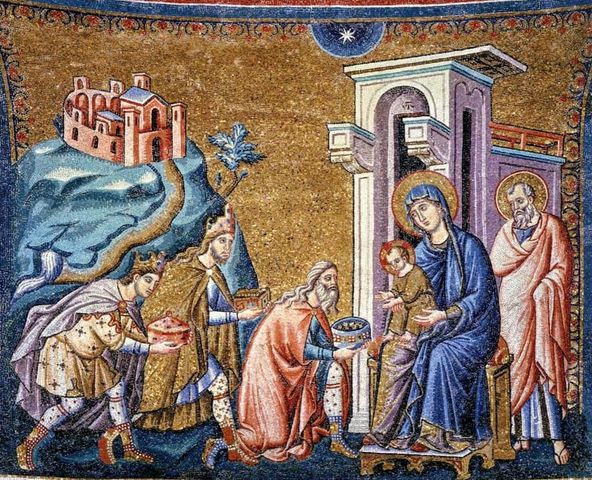
It means, if you have a baby Jesus lying in a manger inside a stable for animals, illuminated by a host of angels in heaven singing Gloria and guiding lowly shepherds to the holy family, please keep it that way. That is how St. Luke portrays Christmas in his infancy narrative. But please do not mix it up with details from St. Matthew. There you won’t find the heavenly angels singing Gloria in his Christmas story. What you have instead, is a star in heaven shining in the dark, guiding the first visitors who are called “wise men from the east”, not shepherds. They come searching for the newborn king from far away to offer him gifts. They find him, not in a stable, but in a regular house. That is how Matthew portrays it in his Gospel, which we always read for Epiphany, the feast we used to call “Three Kings”, which I call Christmas Part Two.
Siguro dahil mahilig tayong kumain ng halo-halo, pati tuloy kuwento ng Pasko pinaghahalo-halo natin. We put all the details together. And we tend to miss the point of either Luke or Matthew by coming up with an ecclectic Belen. Masarap ang halo-halo as a Pinoy dessert. Masarap din ang kare-kare with peanut sauce and bagoong as a festive Pinoy dish. But I doubt if you will still enjoy your halo-halo if you mix it with kare-kare and bagoong. If you reacted and said, “Yuck!”, then good, you got the point. Relish them separately.
In his letter to the Ephesians 2:17, Saint Paul is talking to members of a Christian community made up of Jewish and Gentile converts. He says, Jesus Christ “came and preached peace to YOU WHO WERE FAR OFF (meaning the Gentiles) and peace to THOSE WHO WERE NEAR” (meaning, the Jews). He is echoing the words of the prophet in Isaiah 57:19 “Peace! Peace to those who are far and near, says the LORD; and I will heal them.” When both those who are far and those who are near shall have learned to walk in the light of the Lord, then there will be peace.
In Saint Luke’s Christmas story, not all who are near are able to receive Christ’s peace. It is not the close relatives of Joseph in Bethlehem who enjoy the privilege of hosting the birth of the Messiah. Why? Because they refuse to make room for the Holy Family in their homes. It is rather the shepherds, the poorest of the poor in Israel, those in the margins of the Jewish society who welcome him in their humble dwellings. This is the Lukan story we Pinoys love to dramatize on Christmas eve—the PANUNULUYAN. It is Luke’s way of announcing in advance that it is the poorest of the poor who are in a better disposition to hear the Good News that Jesus would eventually proclaim to Israel.
And of course, in Matthew’s Christmas story, which we read for the Feast of the Epiphany, it is the wise men from the east, meaning, GENTILES FROM FAR AWAY who are guided to Bethlehem by a star to find the newborn king and offer him gifts.
The irony of it all reminds me of the Tagalog saying, “Malayo man, malapit din, pilit pa ring mararating.” That applies well to the Magi, those who allow themselves to be guided by the light of the star, even from far away. Walang malayo sa taong malapit ang loob sa Diyos.
But the ironic reverse of that saying is just as true. “Malapit man, malayo rin. Wala silang mararating.” Jesus, the light of the world, is not found by “THOSE WHO ARE NEAR”, like King Herod who could not find the newborn king, not even if he is guided by all the priests and elders of the Jerusalem temple. Why? Because his mind is darkened by his fear of losing power, which makes him unable to look up to heaven, to allow himself to be guided by the star and to lay down his gifts and offer them.
For Matthew Herod is a manifestation of the darkest, the most wicked, the worst of ourselves. He represents that version of ourselves that has the tendency to be deluded. That tendency to be deceptive, insecure, arrogant, power-conscious, conceited, and murderous.
And yet, history tells us that Herod was actually a very intelligent man, a very gifted builder. But his superior qualities made him conceited. Instead of bringing out the best, it brought out the worst in him. He had gifts but he refused to lay them down and offer them. He didn’t want to kneel before the King of the Universe because the power of his kingship had gotten into his head.
Ironically, the truest, the noblest and holiest in ourselves is represented by a vulnerable little child whose light shines brightly like a radiant star in the dark night, and which guides travelers to their destination. No wonder Jesus would later ask his disciples to become like little children.
This light draws the wise from far away to lay down their gifts in all humility and to adore the Creator, not themselves. Their wisdom consists in discovering that all power belongs only to God. That it is in the apparent weakness of radical love, in the passion motivated by compassion, and in self-emptying generosity that the divine light shines out in the midst of darkness in this world.