
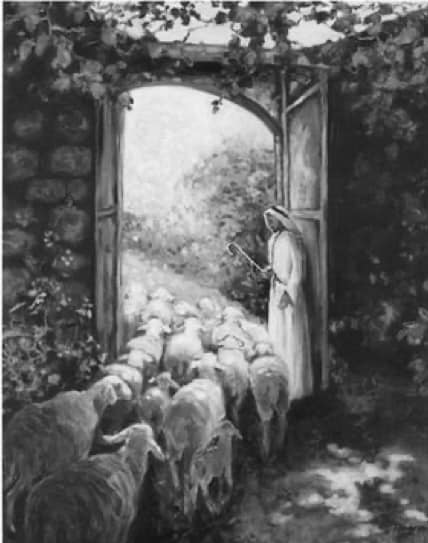
The fourth Sunday of Easter is celebrated as The Good Shepherd Sunday. The pastoral imagery is commonly used both in the Ancient Near East and even in the Greek culture when referring to leaders of the people. In today’s reading (John 10:1-10) Jesus does not refer to him immediately as the good Shepherd (only in v11). Interestingly he explicitly said “I am the gate for the sheep” (vv7,9). Which one is Jesus, then, the shepherd or the gate? From the literary point of view this discourse of Jesus could have been conflated where the two references must have been taken from a different setting; (one cannot be the shepherd and at the same time the gate through which he enters; cf Ps 118:20; John 14: 6). But taking the whole Chapter 10 as a unit He is considered both the Shepherd and the gate.
Focusing on the gate, (on the Shepherd, cf s1S#28, 4/24/21; on the sheep, s1S#58, 5/08/22), the word “thyra”( θύρα ) is used both literally and metaphorically, meaning “gate or door” through which one passes through. Jesus specifically refers to himself as the gate of the sheepfold. It could be interpreted in two senses. First, it refers to the legitimate access to the sheep for those responsible for pastoral leadership in the community, (cf vv1-3, and especially in the context of Jesus’ polemics with the Pharisees in the previous chapter, 9:34f, about the man born blind). Any shepherd who approaches the sheep other than through him (the gate) is a thief and bandit. Secondly, it deals with the sense of security that proper access affords both shepherds and sheep. Jesus is the gate through which one must pass to gain life, to gain salvation, being the divinely constituted and sole avenue to the Father (14:6 “…the way, the truth, the life…”). To find pasture is to find life. Sheep who seek pasture through Jesus find life, life in abundance (v10). The thief can offer only theft, destruction, and death.
May we all see the singular role of Christ, “both Lord and Messiah” (cf 1st reading Acts 2:36f), through whom (the gate) alone is our salvation and fullness of life (John 10:10).
Shepherd
The pastoral language was used figuratively throughout the ancient Near East and in the Hellenistic world. The title shepherd was applied both to gods and kings, (e.g. Hammurabi, god Shamash, cf Nh 3:18).
When used in the OT, ro’ēh ( רֹ֥עֵה ), it is interesting to note that it refers, most of the time to rulers of the people (like the king, royal officers, elders, and judges), in a negative way since God is considered the true shepherd of Israel and the leaders as his subordinate herdsmen often fall short of God’s standards. Thus they were condemned for their infidelity and stupidity, for scattering and leading them astray, (cf Jer 10:21, 22:22, 23:1-4; Ez 34:1-10; Zec 10:3, 11:4-17). David, of course, was an exception and was described as a ruler with an ‘upright heart and a skillful hand, (Ps 78:70-72). Even the Persian king Cyrus, (Is 44:28) was considered God’s shepherd. But going back to the OT’s basic belief that God is the true shepherd, the most extended image is given in Ps 23 and Ez 34, who protects and cares for his helpless flock; (cf also Ps 28,77,100, 121; Jer 23,49,50; Is 40,49; Mi 4,7). And because of the failure of Israel’s shepherds, God promised that he would raise up new shepherds ‘after my own heart’, (Jer 3:15, 23:4), which took a messianic significance eventually, (Ez 34:23, 37:22,24), a shepherd from Davidic lineage, who would suffer on behalf of his sheep, (Zec 13:7, 12:10).
In the NT, the most explicit reference given about the fulfillment of the prophecy is in John 10:1-29 where Jesus refers to himself as the ‘the good shepherd, “poimēn” ( ποιμὴν ), who lays down his life for his sheep’, (cf Mt 26:31; Mk 14:27). Thus in the gospels Jesus claimed that his mission was ‘to the lost sheep of the house of Israel’, (Mt 10:6, 15:24), and seeking the lost sheep exemplifies his love, (Mt 18:12-14; Lk 15:3-7; cf. Mk 6:34); while the separation of the sheep and goats by the shepherd was compared to judgment, (Mt 25:32). In the letters Jesus is called ‘the great shepherd of the sheep’, (Heb 13:20), ‘the shepherd and guardian of your souls’, (1 Pt 2:25), and the ‘chief shepherd’, (1 Pt 5:4).
Jesus is, indeed, ‘the good shepherd’, or practically, he is the model shepherd of each one of us called in the ‘service of shepherding’, be it in the religious or secular context or both. So it is incumbent on each one of us to imitate him. In a special way, we pray and call on our leaders in the government and the church that they may selflessly prioritize the needs of the flock, especially during this pandemic situation, and not their personal and/or political interests. And that they, and every one of us, continue to listen only to the voice of Jesus, the Good Shepherd, and not to the cacophony of voices peddled by hired men or mercenaries through social media.
Hear and follow
The whole of chapter 10 of the gospel of John is about Jesus, the Good Shepherd. He knows his flock; they recognize his voice and follow him. Others do not follow him. This Good Shepherd Sunday the focus is given on the response of the sheep (10:27-30; for the commentary on the good shepherd, cf s1S#28, April 24, 2021).
The true sheep of the Good Shepherd “hear…and follow” him (v.27). In the OT to hear means a careful listening to God and giving heed to him, tantamount to the idea of obeying him, (e.g. Abraham in Gen 22:18; the people in Josh 24:10). This nuance is taken by the NT as well. The word akouõ (ἀκούω) kept the same sense of ‘listen carefully, pay heed to’ especially to the teaching of Jesus, (Mt 11:15, 17:5; Mk 9:7, Lk 16:29). To follow, akoloutheō ( ακολούθεω ) means to follow with a nuance of ‘becoming devoted, attached to, give one’s allegiance to’, and involving a solemn commitment to a person, as is evident in the disciples’ relationship to Christ their leader, the shepherd, (cf Mt 4:20,25; Mk 1:18, 2:14; Lk 5:27ff; John 1:37ff). In short in the context of this Sunday’s gospel, to hear and follow the voice of the good shepherd, Jesus, one must be “of God” (8:47), “of the truth”, (18:37; cf Mt 16:16-17 where Peter recognized Jesus as Messiah and Son of God because of the revelation of the Father, two titles mentioned here in John 10:22-39).
We are at the crossroads of Philippine history, for we are to choose our national and local leaders. This exercise of suffrage is a sacred act. It is good to ask ourselves before casting our votes: is our choice a real product of prayer and discernment as our “shepherds” (priests, bishops, and Catholic lay leaders) have guided us? Is it “of God, of truth”, or “of thieves, of wolves?”. Let us vote for leaders who embody the traits of the Good Shepherd whose life is poured for others, ‘that they may not perish…’ And whether election time or not, every decision we make should always be a moral choice, according to the voice of the Good Shepherd.