
Mt 21:1-11
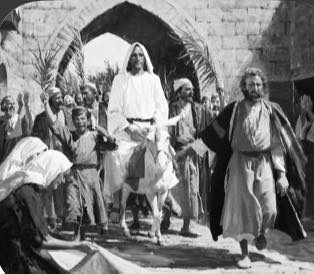
Matthew’s account of Jesus’ entry into Jerusalem begins at the Mount of Olives and involves him sending for a donkey, linking it to scriptural fulfillment.
Jesus’ coming on a donkey was a symbol of peace and humility. Abraham and Jacob both rode donkeys. The kings of Israel would ride a white donkey (Jgs 5:10). While horses were ridden during times of war, rulers rode donkeys during times of peace as a sign of humility toward the people (cf.1 Kgs 1:33-40). And so with the expected messianic king: “Say to daughter Zion, see your savior comes”, (Is 62:11); “your king is coming to you, a just savior is he, humble, and riding on a donkey, on a colt, the foal of a donkey, (Zec 9:9).
The procession has liturgical overtones, with ‘Hosanna’ shouted during Jewish feasts, acknowledging Jesus as Messiah and prophet, causing the city to shake in reaction—an eschatological, cosmic response. This procession’s significance contrasts with the crowd’s later rejection.
Is 50:4-7
The servant of the Lord appears four times in Deutero-Isaiah, described in different contexts: his call (42:1-4), opposition (49:1-7), rejection (today’s reading), and suffering (52:13-53:12). His role is prophetic, offering consolation, especially to the faint-hearted. The servant has endured physical and mental abuse, including being struck and having his beard pulled, but remains steadfast, following prophetic tradition. His identity remains unknown in Hebrew scriptures, but Christian tradition sees him as a precursor to Jesus.
Phil 2:6-11
The Philippians hymn, read every Palm Sunday, is widely seen as an early Christian hymn inserted by Paul. It is poetic, not a strict theological treatise, raising complex questions. The hymn underscores mutual concern and humility in the Christian community, urging believers to act as Christ did (v5). It has two main parts: the descent (vv6-8), starting from divine form to death, and the ascent (vv9-11), elevating Christ to divine equality. In God’s form, Christ did not cling to divinity (v6). He emptied himself (v7), becoming human in appearance and obedient even to death on a cross (v8). This descent is followed by a divine reascent, where God exalts Jesus, giving him the name
Mt 26:14-27:66
Holy Week is the most sacred week in the Church year, beginning with Palm Sunday and concluding on Easter Sunday. Palm Sunday marks the triumphal entry of Jesus into Jerusalem. His arrival in his city of destiny is the beginning of his journey to the Cross. Though called Palm Sunday because of the reception done by the people to Jesus waving tree branches, this Sunday is also called Passion Sunday. Thus the gospel read today is basically the whole passion narrative.
The Matthean passion narrative of Jesus emphasizes divine plan, scripture fulfillment, and Jesus’ true identity. The narrative highlights Jesus’ control, recognition by others, and the participants’ moral contrasts. Key events like betrayal, arrest, death, and resurrection are linked to prophecy and covenant, portraying Jesus as the divine agent overseeing all.
As we begin Holy Week, let us accompany Jesus as he hastens toward Jerusalem and imitate those who met him then, not by covering his path with garments, olive branches, or palms, which delight the eye for a few hours and then wither, but by doing all we can to prostrate ourselves before him through repentance and humility and trying to live as he would wish, taking up our own cross daily so that we may partake in his everlasting kingdom. It is through obedience that Jesus shows his love for his Father. It is by giving up his life in total emptying that he shows his immeasurable love for us. This is a celebration of love that can be understood not through words but through silence and prayer so that it may enter into our hearts. Amen!