From the infancy narratives, which are written from a post-Easter theological perspective, it is impossible to determine how much Mary understood at the time of Jesus’ conception and birth. Pregnancy, birth, and choosing a name are great events for a young mother who goes through this experience for the first time. Only mothers can witness this wonderful time in their lives. Outsiders can only marvel at the beautiful miracle God works in a woman, time and again. All the more in the case of Mary.
In Luke’s gospel, the evangelist comes back repeatedly to her reflection on what God has revealed- in the message of the Angel, the words of the shepherds, and the words of Jesus when as a boy he is found in the temple. This stance of Mary is captured in the expression “she pondered the words/things, in her heart”, (cf. Lk 1:29; 2:19,51). The word “symballō”( συμβάλλω ), used particularly in 2:19, is unique in Luke. Literally ‘tossing or putting (ballō) together (sym)” and can be understood as pondering, thinking about, considering, reflecting. Naturally Mary does not understand clearly all the ramifications of her vocation. But because of her “putting together” what was said to her and what was happening in and around her in her heart, her whole life was a repeated Fiat- “be it done to me according to your word”, (1:38).
We usually fail to realize that our faith life and our relationship with God depend much on prayer as it does on discerning, studying, or counseling. But as we honor Mary, the Mother of God, she is shown to us as reflective and meditative. As a woman of faith, Mary remained close to God. She was a woman of prayer, a disciple par excellence. The Church presents her life as an example for us on the first day of the New Year.
We may not know the whats and the whys of our lives. But we do not have to. Just like Mary we only have to ponder them in our hearts and trust God that everything will turn out well for us, even with its attendant struggles and pains. And so we pray: We fly to thy protection, O Holy Mother of God. Do not despise our petitions in our necessities, but deliver us always from all dangers, O Glorious and Blessed Virgin. Amen. (From the 3rd-century original Greek hymn to Mary).
A blessed Peaceful New Year!
Woman
“But when the fullness of time had come, God sent his Son, born of a woman…”(Gal 4:4)
Eight days after the Nativity of Jesus, the whole Church focuses the Blessed Virgin Mary. She is the Mother of the Son of the Most High, the Son of God. She is the Mother of God. This is her greatest and most fundamental title, the reason for all her other titles and honors. It is by her humble “Fiat,” “Be it done to me according to your word,” (Lk 1:38) that the Eternal Word was made flesh.
In the early centuries, her title was “Theotokos.” The term comes from two Greek words, “Theos,” God, and “tokos,” offspring — she whose offspring is God. Hence, “Mater Dei” in Latin, Mother of God. The term was used by Origen in the 3rd century, and in the 4th century by St. Athanasius of Alexandria, St. Gregory, St. John Chrysostom and St. Augustine.
But Nestorius, the Patriarch of Constantinople, objected to the use of the term. He believed that the right term is “Christotokos,” Christ bearer, to mean that Mary is the mother of the human nature of Jesus, but not of his divine nature. In AD 431, Patriarch Nestorius was condemned by the 3rd Council of Ephesus. The Council declared it as dogma, that Mary is the Theotokos, the Mother of God. Against Nestorius, the Council declared that the divine nature and the human nature of Christ are perfectly united and cannot be divided. Jesus is fully God and fully human. This is what is meant by the title, Mother of God. In 451, the Council of Chalcedon reiterated the condemnation of Patriarch Nestorius.
The celebration of the Feast of the Theotokos goes back to the early Church in Rome. It was, however, overshadowed by the Feasts of the Annunciation and of the Assumption. January 1 became simply the Octave Day of Christmas, the “8th day” on which the Child Jesus was circumcised and given the name Jesus. In the 13th or 14th century, January 1 became known as the Feast of the Circumcision.
In 1962, the name of the feast was again changed. The 1962 Missal of Pope John XXIII simply called it, the Octave of Christmas. Finally in 1969, by decree of Pope Paul VI, we began celebrating January 1 as the Solemnity of Mary, the Holy Mother of God. Today the whole world celebrates New Year’s Day and ushers in 2022. In the early centuries, the Church celebrated the Feast of the Theotokos on January 1, giving the New Year a deep religious significance. Mary has given birth to the Savior of the world. It is the beginning of all years.
May the New Year 2022 be truly a blessed and safer year for all of us, through the maternal care of Mama Mary, the Mother of God and our mother, too. “Holy Mary, Mother of God, pray for us sinners now and at the hour of our death. Amen.
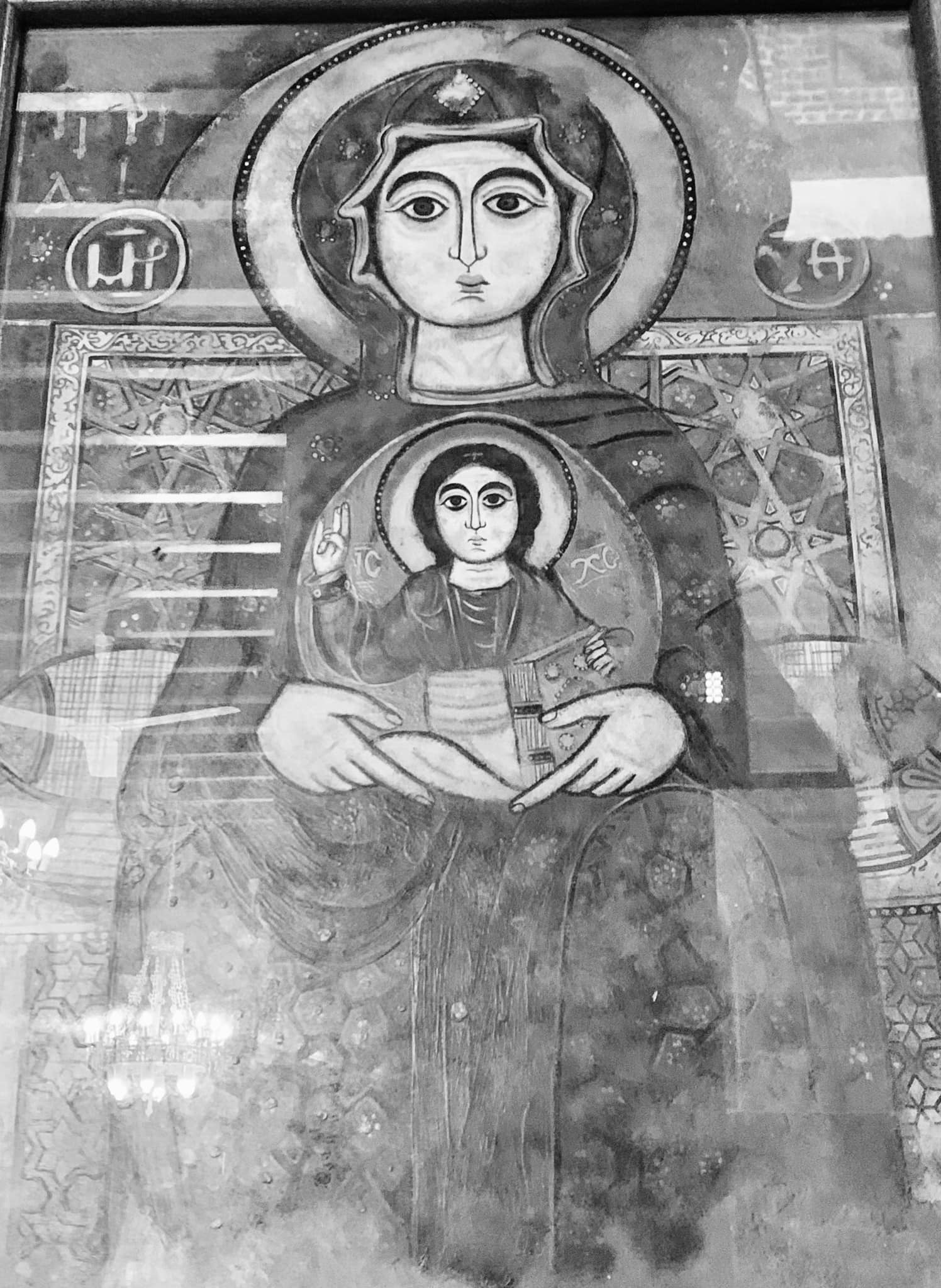
(Icon of Mother Mary and Son Jesus, Gabal- al Teir, Minya. Egypt)