

30th Sunday B
Jer 31:7-9
In one of Jeremiah’s most celebrated chapters, the prophet speaks about the return of the exiles from the northern kingdom, who had been deported by the Assyrians after their victory in 721 B.C. Those who lived through the devastation are now making their return. They are referred to as the “remnant of Israel” (v. 7), a term often used to describe the small part of the Israelite population that was spared during catastrophe, serving as the survivors through whom God’s lasting fidelity will continue (Amos 5:15). Gradually, this remnant acquires the moral qualities appropriate for deliverance (3:13-21). Here, the remnant is identified with the more disadvantaged members of society. Mothers and pregnant women, often mentioned without their husbands, would be dependent on society for support. The blind and the lame, typically seen as bearing the weight of personal or family sins, were viewed in their impairment as imperfect and less than “whole” for community and cult life. These segments of society are the first to be repatriated, as special subjects of Yahweh’s love. Their departure in mourning is met with a joyful return (v. 9a; Psalm 126). This motif of deliverance bestowing special favor upon the physically impaired recurs throughout prophetic literature (Isaiah 35:5ff).
Heb 5:1-6
In today’s passage, the emphasis is on the humanity of Christ as well as his present glorified state. For both reasons, he is uniquely positioned to help his followers. The high priest of the temple was consecrated for God, yet he acted in the interests of humanity (v. 1). Since his role was to offer sacrifices for sins, it was fitting that he sympathize with human weakness. Prone to sin himself (v. 2), he could extend help to those who are also weak. The high priest was designated by the Lord through the line of Aaron (v. 4), ensuring his acceptability and authenticity in exercising his sacred office. In terms of divine appointment, Christ is exceptionally qualified to be a high priest. His divine calling began with his death-resurrection (8:1ff). The text cites two biblical quotes to support his designation as priest (v. 5f): first, a royal psalm where the king is called God’s son (Psalm 2:7), and second, another royal psalm (Psalm 110:4) that further emphasizes his divine appointment. Essentially, the epistle uses these psalm verses to substantiate its claim that Christ was divinely chosen, legitimizing his role as high priest. Thus, Jesus, being both human and divinely appointed, is exceptionally suited to be the high priest of the new covenant.
Mark 10:46-52
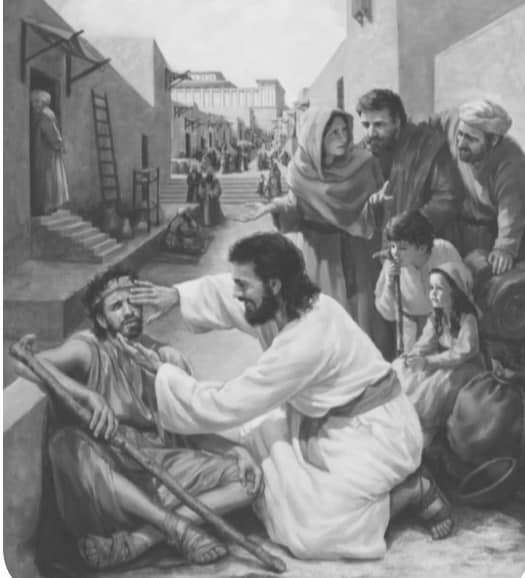
The account of Bartimaeus regaining his sight is Mark’s final miracle before Jesus heads to Jerusalem (v. 46). The blind man recognizes Jesus as the Davidic Messiah (v. 47)—a title that Jesus accepts, although he will later interpret it in a more humble context as he enters Jerusalem (11:1-10). Bartimaeus is one of the few individuals named in Mark’s healing accounts, as beggars often went unnoticed. He persistently calls out to Jesus, even after being silenced (vv. 47). This persistence highlights his faith. Although he addresses Jesus with a royal title, he ultimately requests God’s mercy. His hopes are grounded in a belief that healings were significant in the messianic era, as the first reading indicates.
Interestingly, Jesus’ question to the blind man about what he wants (v. 51) mirrors the question posed to the sons of Zebedee in the prior narrative (10:36). The irony is striking: one request is marked by ambition, while the other is a simple plea made in faith. Bartimaeus’ restored sight is indeed physical, but for Mark’s readers, it symbolizes a deeper meaning. Biblical blindness often represents a lack of faith, while sight is associated with faith itself. In his final statement (v. 52), Jesus reveals the faith dimension: faith not only saves from physical blindness but also from eternal death. The man, now deepened in conviction, follows Jesus “on the way” to Jerusalem with his disciples (v. 52; 10:32). The “way” of Jesus and his followers inevitably leads to Jerusalem and suffering. Bartimaeus transforms from a mere supplicant to a disciple, moving from the risk of being overlooked to a life filled with faith and favor.
Today, many remain overlooked, scarcely noticed, and even excluded around us—the homeless, elderly, unemployed, institutionalized, or simply those who seem lackluster, dull, or uninteresting. Yet, they are special subjects of Jesus’ love. May we all follow him on “the way”, becoming true disciples in both words and deeds. Amen!