
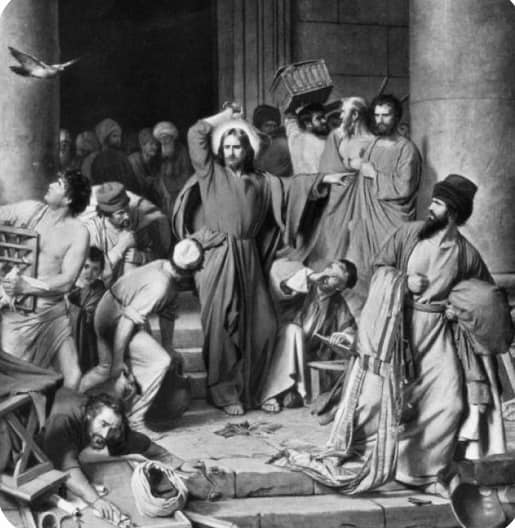
All four gospels has the account of the purification of the temple by Jesus. In the synoptics, it precedes Jesus’ arrest at the end of his public life, coinciding with his only visit to Jerusalem during his ministry: Matthew (21:12-13) and Luke (19:45-47) on the day Jesus entered Jerusalem; Mark (11:15-17), on the next day. But in the gospel today, John places it at the beginning of his ministry (2:13-25) as part of the “book of signs” (1:19-12:50). It should be noted that the order of events in the gospel narratives is often determined by theological motives rather than by strict chronology.
The occasion is the Passover (2:13; for John Jesus makes several trips to Jerusalem, this is the first Passover mentioned; the second in 6:4, a third in 13:1; taken literally, they point to his ministry of at least two years). Animals were sold for use in sacrifice (v14). The money changers collected the sale price and also served to collect the “redemption” tax required of every male Jew at nineteen years of age (Ex 30:11 – 16).
The event becomes a “sign” for John (cf s1S#41 Sign, 25/07/21) which Jesus offers for belief. Jesus’ action of cleansing the temple was seen as eschatological as the Scriptures foretold would come about at the time of the messianic era (Mal 3:1-4; Zech 14:21), precipitating the Jews’ request for his messianic credentials, and presaging
the hostilities between Jesus and the Jewish religious authorities.
Jesus’ response to the “sign” request is another example of John’s “two-level” approach. The word “temple” (cf s1S#21 Temple 07/03/21) takes on two meanings (vv19f). Jesus responds on the higher, spiritual level, speaking of his body as the temple; his adversaries remain on the natural level, speaking of the material edifice (v20). In other words, through Jesus’ death-resurrection, the temple will be superseded by the new reality of a “Spirit-filled” Christ. As the passage makes clear (v22), it is only in the post-Easter reality that the full significance of the words and events will be understood. At that time Jesus’ words will have equal weight with all of God’s revelation
The substitution of Jesus for the temple points to him as the locus of the divine presence in the new era (1:51), a fact which will call for an entirely new approach to worship, centered in a new relationship between God and the believers, not tied to physical location (4:22ff). May our worship go beyond the churchgoing and rituals. Rather, may we be able to establish our relationship with God first, that which gives meaning to our worship and liturgies in the church. Amen!
s1S#41 Sign 25/07/21
“….The term ‘sign’ in the Bible generally means a significant event, act, or other manifestation that presages God’s presence, intention, or revelation. In the OT, ‘ôt ( א֥וֹת ) could be miraculous or spectacular (like those performed by Moses: Ex 4:1-9, 17, 30, ch. 7-11); or maybe a natural phenomenon (e.g. rainbow, Gen 9:12 ff; circumcision, Gen 7:11; cf also Gen 4:15; Is 8:18); or divine revelation, with or without an accompanying miracle, (Ex 3:12, 13:9ff, 31:13ff; Ez 20:12, 20; 1 Sam 2:34)…In the NT, the term sēmeion ( σημεῖον ) tends to be miraculous or even apocalyptic, ranging in meaning as in OT from a distinguishing mark to a significant revelation, usually though not always, accompanied by a miraculous omen. Easily identifiable are signs or miraculous deeds performed by Jesus as indicators of his divine person and authority and could only be truly understood through the eyes of faith, (cf John 2:11,23, 3:2, 4:48,54, 6:2,14,26,30). Thus in the Gospel of John, they are referred to as signs rather than straightforward miracles, portraying events in Jesus’ life all of which point to a deeper reality in the life of the faith community. Taking for example the multiplication of loaves, (the only miracle of Jesus found in all four gospels, cf. John 6:1-15; Mk 6:34-44; Mt 14:13-21; Lk 9:10-17), there are two levels of understanding- one centering on the event itself and second on the meaning in the life of the church. Note that this narrative precedes the bread of life discourse, where the loaves are already seen as symbolic of Jesus himself as well as of the Eucharist (6:22ff). The providing of food symbolizes the nourishment to be found in the words of Jesus as well as the sacrament…”
s1S#21 Temple 07/03/21
“…The Temple, hêkāl ( הֵיכַ֤ל ), primarily refers to the dwelling place of God among his people, and explicitly to the Jerusalem temple, the central focal point of Israelite worship, (2 Kgs 18:16; 2 Chr 26:16; Jer 7:4; Amos 8:3; Jonah 2:4). Keeping the sense of a ‘dwelling place’, the temple is also referred to as bayit ( בַּ֙יִת ), the ordinary word for house, (2 Kgs 11:10, 13, 24:13, 2 Chr 29:16). In the NT, hieron ( ἱερóν ) usually refers to the temple at Jerusalem, ((Mt 4:5, 21:12ff; Mk 11:11ff; Lk 2:27, 19:45ff; John 2:14,15; 8;20; Acts 2:46; 5:20ff; 1 Cor 9:13). A synonymous word, naos ( ναὸς ), is used to refer to the inner sanctuary of the temple complex, (Mt 23:16ff; Mk 14:58; Lk 1:9,21; John 2:19ff; 2 Thes 2:4; Rev 3:12, 11:1,2) and in particular the “holy of holies”. Even the word oikos ( οἴκος ) the term for the house is also used to refer to the temple, (John 2:16). But naos is metaphorically used also to refer to the “temple” of the body of Jesus (John 2:21). Thus the shift in the theological dynamic of the temple motif: from the OT’s temple worship focused on a physical structure and external ritual, to NT’s transcending the infrastructure of worship and concentrating more on the person of God in Christ and the spiritual realities of the temple phenomenon to which the old covenant pointed. This is the significance of the rending of the veil that screened off the “holy of holies” (cf. Mt 27:51; Mk 15:38; Lk 23:45). After the death of Christ, access to God and the blessings of forgiveness and atonement were no longer limited by restricted passage to an inner sanctuary through the mediation of an earthly priesthood once a year…Christ is the new temple. He put an end to the old way of worship and inaugurated a new one- “in spirit and truth” (cf. Jesus’ conversation with the Samaritan woman, Jn 4:20-24). Our worship and liturgies would make sense only if it is rooted in our personal relationship with Christ and will continue in all that we do and say…”