
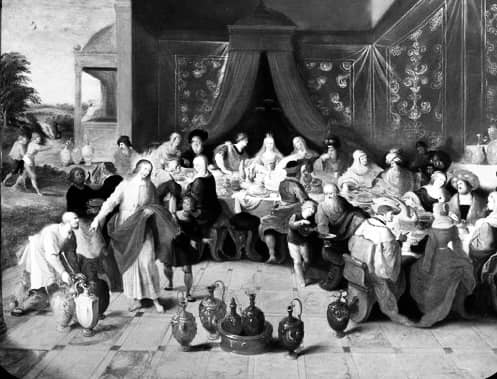
The wedding is a common imagery used in the Bible to describe the future messianic kingdom (Jer 33:11, 14-16; cf. 16:9). The return from exile was to be such a celebration with the faithful soon to be clothed with “the garments of salvation,” the “robe of righteousness” as God’s bride (Isa 61:10; cf. 62:1-5). In Jewish and early Christian writings, the kingdom of God is often compared to a banquet. Jesus’ meals with tax collectors and sinners and especially his Last Supper with his disciples symbolized what life in God’s kingdom will be like. And so the use of the royal wedding banquet to teach about the kingdom of heaven is part of a rich tradition (Mt 22:1-14). The term “gamos” ( γάμος ) means not only the marriage itself but includes the accompanying wedding banquet or feast.
Jesus addresses this third parable again to the chief priests and elders of the people, continuing the commentary on the controversy between Jesus and the religious leaders of Israel (Ch. 21-23). While similar to Luke’s great supper (14:15-21 ), the distinctive motif of Matthew is an invitation, and from a king at that, and how the invitees responded. Among the invited guests are a landowner and a business person (v. 5), definitely members of the elite class. Notice also the double invitation: “The king sent his slaves to call those who had been invited. . . Again he sent other slaves, saying ‘Come!’ (vv. 3-5).
The parable should be understood as an allegory outlining salvation history. God offers the celebration of the kingdom to those invited, the people of Israel. Servants sent to call the invited represent the prophets since the exile who have called the people to return to God to carry out their God-given purpose. Israel, however, has not listened to the prophets. Other prophets were sent to call the invited, expressing greater urgency for “everything is ready.” but again those invited proved to be more interested in their own pursuits. Others insulted the prophets and killed them (cf. v. 35).
The destruction of the faithless by the king’s armies and the burning of their city is a repetition of Israel’s situation before Jerusalem was destroyed by God’s “servant” Nebuchadnezzar (Jer 25:8-9). The message to the Jerusalem leaders is that their rejection of the invitation will soon lead to a repeat of that destruction, (v7, a description after the fact of what happened to Jerusalem in A.D. 70).
Nevertheless, the celebration will go on, and this time God’s servants will invite not only the lost sheep of the house of Israel but also tax collectors, sinners, and Gentiles to participate (cf. 28:19).
As the parable ends (in vv11-14) it provides a warning that mere admission is not enough; an appropriate response is needed. Those invited to the celebration must give evidence of their commitment, and so the judgment (v. 13) is the same as that visited on all those who lack faithfulness (cf. 8:12; 13:50; 24:51; 25:30). The people of Israel had always regarded themselves as God’s chosen, but Jesus points out that it is only those who respond with fidelity to the call who are “chosen” (cf. Isa 41:9; 42:1; see also Matt 24:22, 24, 31).
We are all invited to the banquet. Let us be grateful then to ‘the Lord of hosts…who provide for all peoples a feast of rich food and choice wines’, (cf first reading: Is 25:6-10). But we should go there appropriately dressed, clothed with good deeds and a life of righteousness. Amen.