

11,463 total reads
Acts 12:1-11
This passage highlights Peter’s role as a leader of Christ’s followers after His Resurrection and Ascension. For a decade in Jerusalem, he preached, performed miracles, and converted many. He later traveled to Rome, becoming the first Bishop and guiding the Church through persecution. Around 64 AD, he was martyred, traditionally said to be crucified upside down, claiming he wasn’t worthy to die like Jesus. St. Peter’s Basilica stands over his tomb.
2 Tm 4:6-8. 17-18
Paul, in his second letter to Timothy during his Roman imprisonment, reflects on his imminent martyrdom and describes his life as a sacrificial offering to the Lord (v6). He uses athletic imagery to express that he has completed his mission and maintained his faith, indicating his expectation of receiving a “crown of righteousness” upon the Lord’s return (v8). He briefly mentions his trial, highlighting an opponent named Alexander the coppersmith and his feelings of abandonment, yet emphasizes that the Lord stood by him during this difficult time. He concludes with confidence in God’s protection as he looks forward to his heavenly reward (v18).
Mt 16:13-19
This passage highlights Peter’s profession of faith in Jesus as the Christ and Son of the living God, emphasizing his unique authority in the early church. This incident at Caesarea Philippi illustrates the expansion of Christological and ecclesial understanding in Matthew’s Gospel, particularly with the use of the term “church” (ekklesia). Peter’s recognition of Jesus transcends the basic acknowledgment of his messiahship, resulting from divine revelation.
The narrative presents Peter as the foundation of the church, known as “Rock” (Petros), with authority to bind and loose, symbolizing community leadership and decision-making. The passage reinforces that the church’s authority and teachings are rooted in Peter’s faith and underscores the enduring significance of this authority even twenty years post-Peter’s death. Finally, it concludes with the instruction for silence about Jesus’ messiahship, linking to the theme of the suffering Messiah.
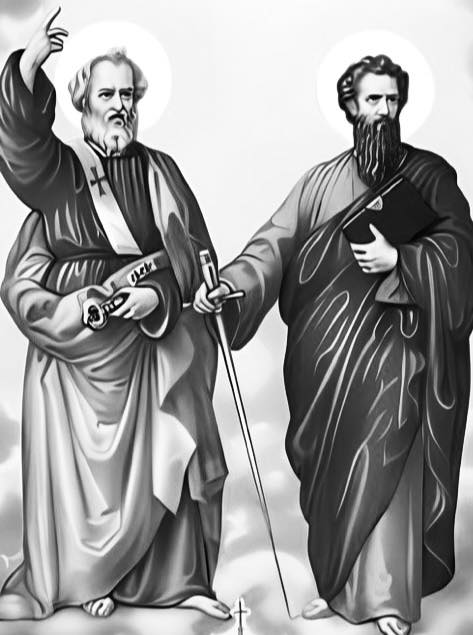
As early as the year 258 AD, there is evidence of an already lengthy tradition of celebrating the solemnities of both St. Peter and St. Paul on the same day. Together, the two Saints are the founders of the See of Rome, through their preaching, ministry and martyrdom there. As the Church’s foundational pillars, Peter, the first Vicar of Christ, represents the Church’s leadership, stability, and unity; while Paul represents the Church’s mission of evangelization through his missionary journeys. He is the Church’s first theologian for his Letters that expound on the Gospels.
St. Augustine of Hippo said of Sts. Peter and Paul, “Both apostles share the same feastday, for these two were one; and even though they suffered on different days, they were as one. Peter went first, and Paul followed. And so we celebrate this day made holy for us by the apostles’ blood. Let us embrace what they believed, their life, their labors, their sufferings, their preaching, and their confession of faith.” Amen! St. Peter and Paul, pray for us!