


1,821 total reads
3rd Sunday Lent (A)
Ex 17:3 – 7
This narrative describes how God provided water for the Israelites during their desert journey in two accounts. The first occurs earlier when they complained about bitter water (Ex 15:22-25). In this second story, the people, lacking water, dissent, driven by their failure to recognize God’s past deeds. They regret starting their journey and consider returning to Egypt (Num 14:3f). Yahweh commands Moses to strike a rock to produce water, with elders present (vv5f); water immediately appears. The site is called Massah (‘testing place’) and Meribah (‘quarrel’), reflecting the events and memory. Numbers, from the priestly tradition, links this to a similar incident at Kadesh in the Negeb, with Moses and Aaron also guilty of sin. These are likely two versions of the same event, told differently over time. The final verse (v7) captures the people’s conflicted feelings.
Rom 5:1-2, 5-8
The reading highlights that God’s abundant grace was poured out through the Spirit after Jesus’ death, unmerited by humans. Enmity and alienation between sinful humanity and God are reversed through faith-justification, granting access to God and peace with Him. This grace also pledges future hope—an assured certainty, not mere wishful thinking—manifested through the Holy Spirit, who pours out God’s gifts. Paul contrasts the gift from Christ with the inherited evil from Adam, emphasizing that Christ’s sacrifice, even for the unworthy and guilty, reinforces the hope of future glory, making the next step almost certain.
Jn 4:5-42
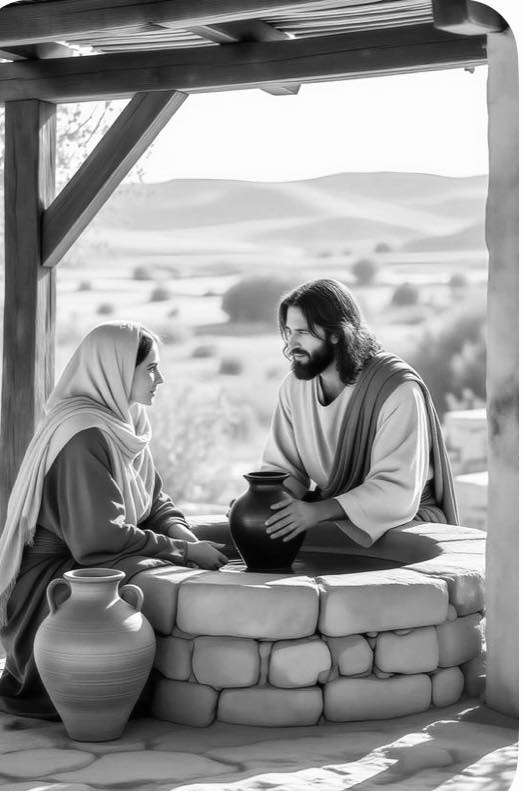
This chapter in the gospel describes a baptismal theme centered on living water, faith in Jesus, true worship, and mission. Jesus encounters a Samaritan woman at Jacob’s well, engaging in a conversation with two levels of understanding: a natural and spiritual one. He offers ‘living water,’ representing the Spirit and eternal life, surpassing natural water and Jewish beliefs. The woman’s faith grows as she recognizes Jesus as the Messiah, and she becomes a mission bearer, leading others to Christ. True worship, moving beyond physical locations, is rooted in Spirit and truth, fostering internal, familial connection. Jesus’ mission parallels the harvest metaphor, emphasizing the early church’s role in reaping the results of earlier planting.
Today’s scripture highlights baptism, prefigured by Moses providing water during the exodus. Jesus refers to himself as the source of living water in his conversation with the Samaritan woman, symbolized by baptism. Paul reminds us that the Spirit’s water has been poured out abundantly. As baptized disciples, may our faith grow swiftly like the Samaritan woman’s, fulfilling our mission to proclaim Jesus as the ‘fountain of living water’ and the Savior of the world. May we all continue to grow in faith and mission. Amen.