


13,024 total reads
15th Sunday A
Is 55:10-11
In antiquity, spoken words were an extension of the person, often embodying the speaker’s characteristics. God creates with a word, which carries divine power. Words, especially blessings and curses, were permanent and sacred, reflecting God’s nature. Second Isaiah emphasizes God’s word’s effectiveness in yielding results, notably Israel’s return from exile (55:12f). This event is assured because of Yahweh’s truth and power, likened to rain and snow sent from the heavens (v10). These waters fulfill their mission, returning to their source. Similarly, God’s word will achieve its purpose, chiefly the return from exile
Ro 8:18-23
Paul depicts all creation sharing in humanity’s hope for final redemption. He contrasts current anxiety with God’s Spirit revealing His children, anticipated by creation. The sub-human world was cursed with Adam and made part of Noah’s covenant, subjected to sin’s chaos but with hope of liberation. Both humans and creation cry out for full redemption, like labor pains. The Spirit’s first fruits promise future resurrection and final redemption. Baptism seals adoption, completed at resurrection. God’s work through Christ unites humanity and creation in hope of new creation in Revelation.
Mt 13:1-23
Chapter 13 of the gospel of St. Matthew is called the “book of the parables” because of the way Jesus preaches and the reason for doing so. In Chapter 11 Jesus started receiving opposition to his message, especially from the Jews. In the later part of Chapter 12, they even asked Jesus for signs. So he resorted to parables which, according to him, will be understood only by those who are willing to listen and believe in him, (cf 13:10-17).
The ‘parabolē’ ( παραβολῆ ) has the same character as ‘māshāl’, ( מָ֭שָׁל ) of the Wisdom books in the OT. This literary form compares or likens one thing with another but intends to refer to something more or even something other than was described. It obliquely presents an intangible truth, clothed in the language of daily life.
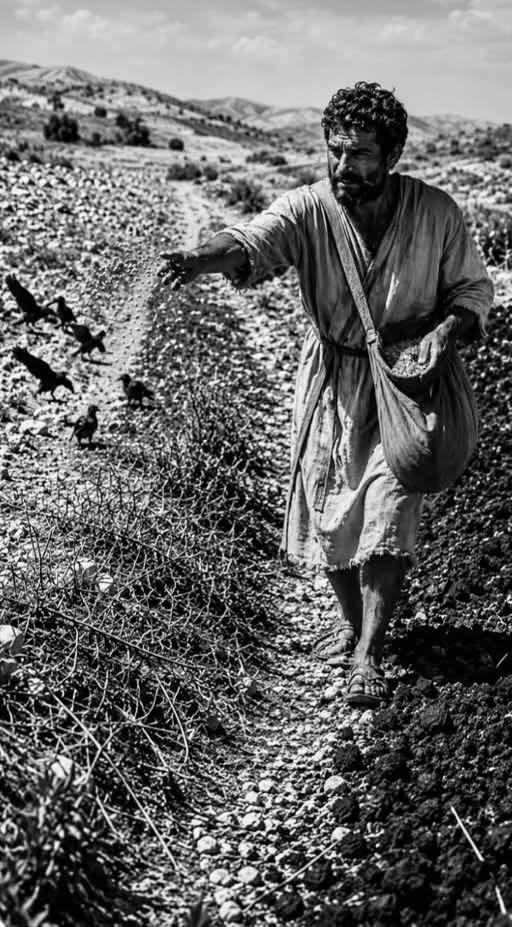
The Parable of the Sower (vv1-23) is the first of Jesus’ seven illustrative stories in the chapter drawing on Palestinian life and culture. The farmer scattered the seed before plowing, with the result that a fair amount was lost even though there was a sufficient yield where the soil was fertile. The point is that, grasped by the ears of faith (v9), the message Jesus delivers, despite its apparent ineffectiveness, will ultimately meet with great success. Just as the seed fell on the path (v4, 19), on rocky ground (v5, 20), or among thorns (v7, 22), so too with God’s word. Many people will not be receptive. But just as there is always rich soil (v8, 23), to receive despite the fall-out, so too the authentic hearers (who listen and understands, v 13), of Jesus’ message will be many and strong in faith.
(from: Parable 2, s1S#146 <7/15/23>)
Today’s scriptures, using agricultural language, speak of the effectiveness of God’s word. Isaiah tells us that just as the rain brings about desired results in fertile soil, so too God’s word moves steadily toward its final purpose. However, in Jesus’ parable of the sower, we are also reminded that not even God can effect more in the human heart than good will allows. As the word of God is sown into our hearts again, do we hear and listen to it, understand it, and act on it even in the face of adversity, material concerns, and temptations? Do we embrace the truth and deepen our commitment to the message of Jesus by a life of prayer, ongoing formation, and education in the faith, and living it in service of others? If we do, it will surely produce a hundredfold. Amen.