

12,857 total reads
14th Sunday A
Zech 9:9-10
The reading describes the emergence of the messianic king, a peaceful, just, and humble leader from David’s line, whose reign extends from the Mediterranean to the Persian Gulf and from the Euphrates to southwestern Europe. This king, depicted as meek and dependent on Yahweh, symbolizes deliverance through justice and gentleness, not military power. His entrance into Jerusalem is seen as a fulfillment of this prophecy.
Rom 8:9, 11-13
Paul discusses contrast between flesh and Spirit in the Christian life. Baptism signifies dying to unredeemed flesh, which is different from mere carnality, and being rooted in the Spirit of God or Christ. The Spirit opposes flesh, conferred on Christ by the Father and given to believers, making coexistence impossible. Although flesh persists daily (Gal 5:17), Christians are spiritually rooted, and the Spirit signifies resurrection (v11). God causes resurrection for Christ and believers, with Christ as the model of new life (1 Thes 4:14; Phil 3:21). Paul then urges moral living: flesh leads to destruction and spiritual death, while Spirit-led life produces eternal life through its fruits (Gal 5:22f).
Mt 11:25-30
The gospel contains Jesus’ praise of God for revelation and an invitation to come to Him, emphasizing humility and openness. Jesus, presenting Himself as true Wisdom and God’s expression, reveals the divine mystery through His deeds and teachings. The invitation echoes Sirach’s call to Wisdom, promising freedom from law’s burden for those who accept His yoke, which exemplifies a righteous yet accessible path. This high Christology aligns with Matthew’s portrayal of divine presence in Jesus, offering a simpler yet profound spiritual commitment.
Jesus offers a light yoke of repentance and faith, contrasting the heavy burden of legalism and self-righteousness imposed by the religious leaders of his time. His teachings, as the divine revealer, provide rest and guidance, making the commitment to follow Him both simple and profound. As we respond to Jesus’s invitation to come to Him, may we recognize Him as the Teacher, the message, the teaching, and the revelation of the Father Himself—He and the Father are one. And whenever we grow tired of “running the race and fighting the good fight,” as St. Paul says, Jesus assures us not to worry and promises to refresh us because we are doing His work. Amen!
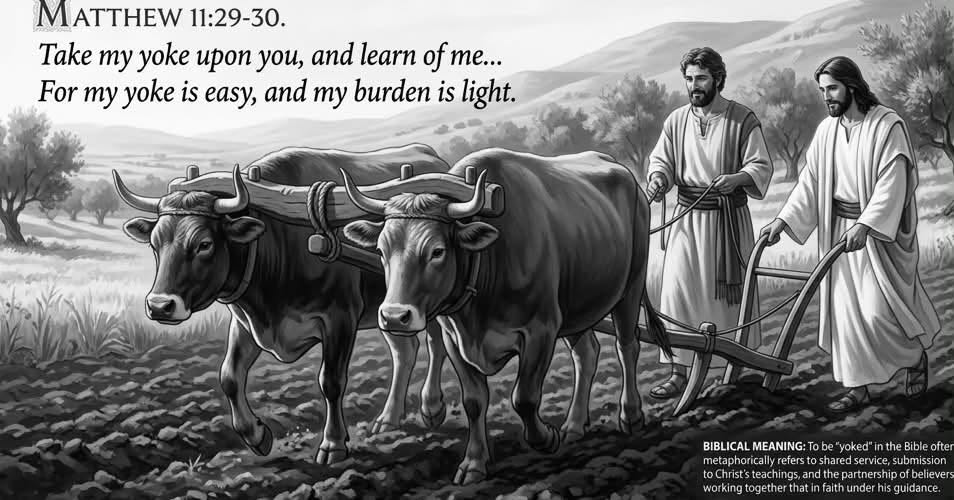
The noun “zygos” (ζυγός) is figuratively understood as “yoke” throughout all six occurrences in NT (Mt 11:29, 30; Acts 15:10; Gal 5:1; 1 Tm 6:1). From the literal “yoke” which refers to an instrument designed to keep a pair of beasts of burden walking and working in tandem, it could mean, metaphorically, enslavement, oppression, or even punishment. During the time of Jesus, the lives of the tenant farmers were governed by the wills and whims of their landlords. Their lives as rustic folk were further controlled by religious leaders who grew fat on tithes that they hoarded in the temple instead of redistributing them to the needy. They laid the “yoke” of their 613 commandments on their followers who sought their advice on how to be righteous and please God, (cf Mt 23, esp. v4). No wonder a lawyer, making some sort of prioritization a necessity, asked Jesus which of these is the greatest, (Mt 22:36).
In today’s Gospel, (Mt 11:25-30), the invitation to come to Christ as the divine revealer, who is both the agent and the content of the mystery of God (v27a,27b), echoes Wisdom’s call found in Sirach 51:23-27: both begin with the praise of God (v25-26; Sir 51:1) and the description of the kind of yoke follows. In contrast to loads of legal obligations placed by Jewish leaders, Jesus promises to all who come to Him that He will give them rest from the heavy burden of trying to earn their way into heaven and rest from the oppressive yoke of self-righteousness and legalism. Jesus understands that any kind of law-keeping is burdensome and amounts to a “heavy yoke” of oppression because no amount of law-keeping can bridge the gap between man’s sinfulness and God’s holiness. But his yoke is light and easy to carry because it is the yoke of repentance and faith followed by a singular commitment to follow Him, (’take up your cross and follow me’, 10:38). As the apostle John says, “For this is the love of God, that we keep his commandments. And his commandments are not burdensome” (1 John 5:3). Furthermore, it is easy to bear because they receive the yoke of a leader who, in the spirit of Zechariah (cf. 1st reading 9:9-10), comes in the spirit of the the “anawim” as lowly and gentle (v29). While requiring a righteousness that surpasses that of the Jewish leaders (5:20), Jesus offers both the end and the means which makes the commitment both simpler and profoundly engaging. And continuing the image of the yoke of the beast of burden, it will, as if, be carried in tandem with Jesus, which makes it lighter to bear. For he offers the teaching of the upright way and the spiritual force to observe it.