
FROM REVOLUTION TO RECONCILIATION
420 total reads
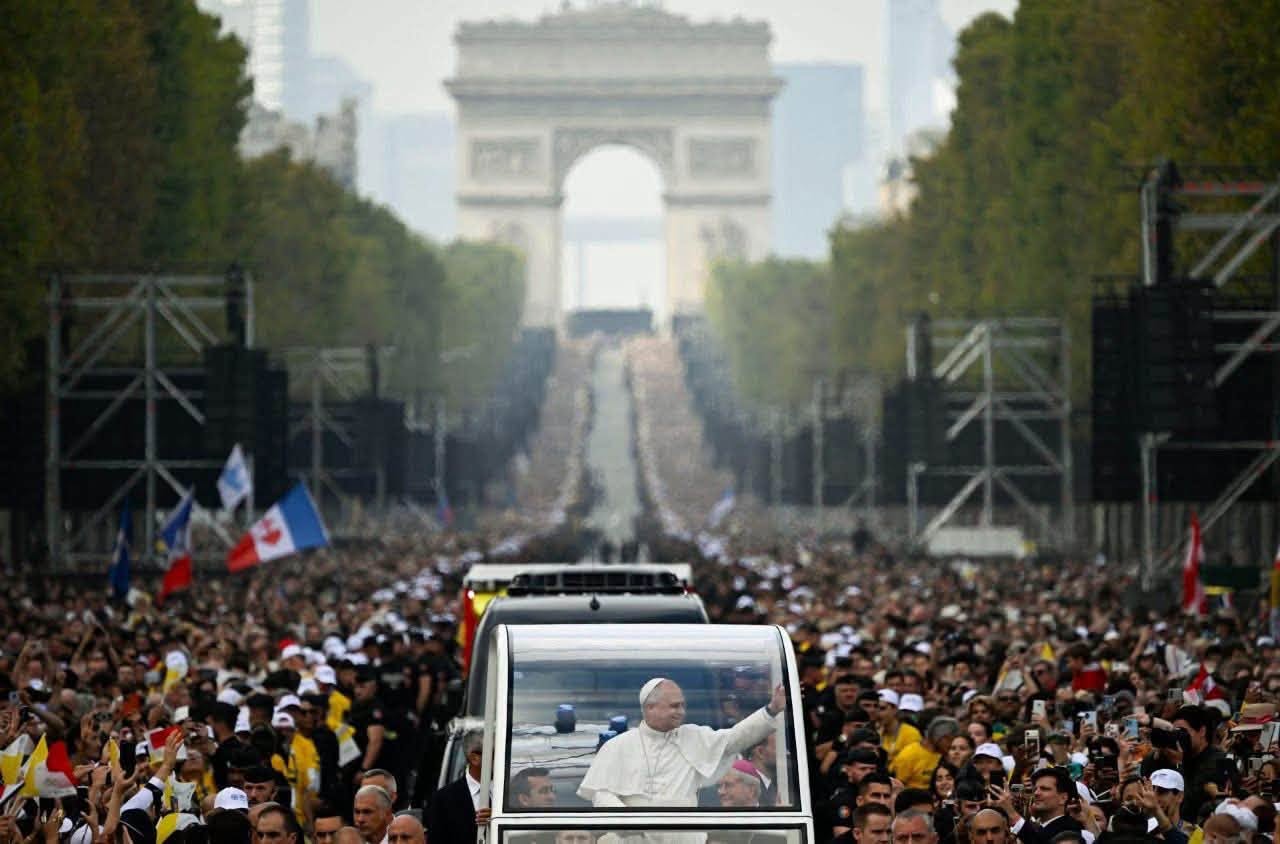
My French friend Eric Nicolas, a native of Marseille, sent me a message yesterday that made me look at one particular moment of Pope Leo’s visit to France in a different light.
Eric admitted that before the visit he had been worried: would France still turn out to welcome a Pope? Then he saw the enormous crowds and wrote to me: “How wrong I was. What Pope Leo did to France is incredible… What is happening in France is like a miracle.”
But what struck me most was something else he noticed—the place where Pope Leo celebrated the great Mass in Paris: the Place de la Concorde.
Eric reminded me that during the French Revolution this was called the Place de la Révolution. The guillotine stood there, and more than a thousand people were executed on that square during the Revolution, including King Louis XVI, Queen Marie-Antoinette, Danton, and many others.
“Silently,” Eric wrote, “it became a Mass for reconciliation as well… away from death and looking forward in love and peace. Was it done on purpose? I don’t know. But wow, what a symbol!”
I thought: indeed, what a symbol.
The relationship between France and the Catholic Church has been marked by deep wounds. Before the Revolution, the institutional Church had become closely identified with the monarchy and the social order of the ancien régime. Bishops and clergy enjoyed privileges that made the Church, in the eyes of many revolutionaries, part of a system they were rebelling against.
But revolutions can also devour their own ideals. The struggle against privilege eventually gave way, especially during the Terror, to violent dechristianization and persecution. Churches were closed and desecrated, priests and religious were imprisoned, exiled or killed, and the revolutionaries who had risen against tyranny themselves became capable of terrible tyranny.
And yet France did not cease to be a land of extraordinary Christian spiritual vitality. It gave the universal Church St. Vincent de Paul, who organized charity and service to the poor into a powerful Christian movement. It gave us St. Margaret Mary Alacoque and Paray-le-Monial, from which devotion to the Sacred Heart spread throughout the Catholic world. It gave us St. John Mary Vianney, the Curé of Ars, patron saint of parish priests.
It gave us St. Thérèse of Lisieux, whose “Little Way” taught generations of Christians that holiness does not necessarily consist in doing extraordinary things, but in doing the smallest things with extraordinary love and childlike trust in God.
It gave us St. Charles de Foucauld, who dreamed of becoming a “universal brother,” living the hidden life of Nazareth among people of another faith and culture.
France gave us Lourdes and St. Bernadette, and the remarkable ministry to the sick that grew around that sanctuary. And in our own time, a little village called Taizé became one of the places where generations of young Christians—Catholic, Protestant and Orthodox—have discovered the beauty of silence, Scripture, simple prayer, fraternity and reconciliation.
And one could add Chartres, the Assumptionists, the Good Shepherd Sisters, the great French missionary congregations and schools of spirituality and theology that have left their mark on the Church throughout the world, including our own Church in the Philippines.
Perhaps this helps explain why I have been so moved by Pope Leo’s visit. He has not come to France to reopen the wounds of the Revolution, to reclaim some lost political privilege for the Church, or to resurrect the ancien régime. He has come with a very different language: human dignity, fraternity, dialogue, healing, reconciliation and peace.
And so I keep returning to that image of the Mass at the Place de la Concorde. The square itself has undergone a kind of conversion. It was once the Place de la Révolution, associated with the guillotine and the Terror. In 1795, it was renamed the Place de la Concorde—the Place of Concord—as France sought reconciliation after the bloodshed.
And there, more than two centuries later, hundreds of thousands gathered around an altar. Pope Leo began the Mass by recalling the words of the Psalm: “How good and pleasant it is when brothers and sisters dwell together in unity.” He spoke of Christ as the source of the deepest things for which the human heart thirsts—for life, truth, unity, peace, communion and happiness.
I do not know whether the historical symbolism of that particular location was deliberately intended by the organizers. Perhaps it was. Perhaps it was not.
But sometimes a place itself preaches the homily. Where once stood a guillotine, there stood an altar. Where crowds once gathered to watch people die, an enormous crowd gathered to celebrate the Eucharist. Where France once spoke the language of revolution and counter-revolution, Pope Leo spoke of communion.
From death to life.
From division to concord.
From violence to reconciliation.
From an armed world to what Pope Leo has repeatedly called an “unarmed and disarming peace.”
Perhaps that is one of the quiet miracles my friend Eric was seeing in France.