
93 total reads
29th Sunday A
Is 45:1, 4–6
Deutero-Isaiah uniquely honors pagan ruler Cyrus. After conquering Babylon in 538 B.C., he freed the Jews, restored their homeland, and ordered the temple rebuilt. The passage portrays Yahweh installing Cyrus as king, using language also applied to Israelite kings (Ps 2:7ff; 110:Iff).
“Anointed” (v. 1), source of “Messiah” and Greek *Christos*, refers to a king’s accession. Here it figuratively identifies Cyrus as Yahweh’s agent against his opponents, chosen for Israel’s sake (v. 4).
That Israel’s God directs a world power underscores Isaiah’s absolute monotheism (vv. 5–6; Is 43:10; 44:6; 46:9). Though Cyrus served Bel-Marduk, Yahweh guides him unbeknownst to him, so all people will recognize Yahweh as the sole God (v. 6): in the thinking of the time, the God who acts is the God who exists.
Thess 1:1–5
The opening follows the classical letter form (v. 1): sender, recipients, and greeting. Paul names co-workers Silvanus (Silas; Acts 15:40t) and Timothy (Acts 16:1ff) as joint senders, addressing the “church of the Thessalonians.” Here, “church” means a local community of believers—the qahal of God, called into being by God. Like the wider church, it embodies faith, ministry, and worship. “Grace and peace” describes the Spirit’s gift, restoring harmony with God and neighbor. The church lives in Jesus, Messiah and Lord, in relation to God the Father, named first.
Paul recalls the community in his prayers (v. 2), the primary bond among early churches. He names their faith, love, and hope—the earliest grouping of these virtues (v. 3). Their “work of faith” and “labor of love” put these virtues into action. Hope comes last because Christ’s return is a major theme; the Thessalonians sustain it through vigilance (5:4–8). Their election assures them of God’s love (v. 4). Paul says “our gospel” bore fruit in Thessalonica (v. 5), referring not to its content but to its reception. The Spirit accompanied the preached word, enabling acceptance (1 Cor. 12:3); God’s power surpasses human eloquence (1 Cor. 2:1–5). Paul’s conduct served his mission, reflecting the conviction and integrity he brought to the task.
Mt 22:15–21
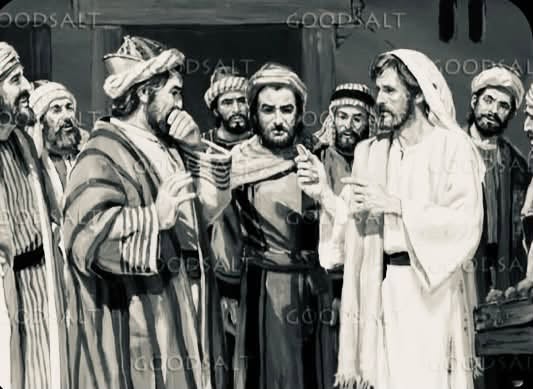
In today’s Gospel, Jesus’ opponents present him with a dilemma. Matthew emphasizes the Pharisees, formidable antagonists in his church, while the Herodians—a political, not religious, party—play a secondary role and had largely disappeared by then (vv. 15–16).
Both groups accurately, if hypocritically, recognize Jesus’ integrity (v. 16). Paying the Roman tax would offend religious Jews such as the Pharisees, though not the Herodians (v. 17). Refusing to pay could brand Jesus an insurrectionist like the Zealots and create trouble for the Herodians.
Jesus answers cautiously, aware of their malice and hypocrisy (v. 18). Asked to produce a coin, his opponents trap themselves: they use Caesar’s services and implicitly acknowledge his authority. The coin bears Caesar’s image and title (v. 20).
“Repay to Caesar” (v. 21): Those who benefit from Caesar owe payment. Jesus offers no political-religious theory; he redirects the question, which concerns temporal matters outside his mission and unrelated to God’s reign. Those who use public roads and facilities pay for them. The New Testament neither questions civil authority (Rom 13:1–7; 1 Pet 2:13–17) nor gives it importance in God’s reign.
“Repay to God” (v. 21): The Pharisees have repeatedly opposed Jesus, God’s emissary, provoking some of his harshest words (Mt 23:1–11). Jesus turns from Caesar to call for respect for God’s will. God’s authority is not shared with Caesar; our response to God must be total. Civil authority is secondary. When we submit fully to God, lesser authorities’ concerns are met. Allegiance to God must remain absolute.
The scriptures illustrate the relationship of both Israel and the early Church to civil governments. Those relations were sometimes positive, (cf first reading, Is 45:1, 4-6), and sometimes negative (1 Mac 1ff). In today’s gospel, Jesus’ answer is balanced and does not “tip the scale” in either direction. There is no reason why we Christians cannot be good citizens (or even good elected officials). Hopefully, we bring to the task a conscience formed in faith. For conscience remains the litmus test of all our behavior. All of us live in the human city, but we are always mindful of our primary citizenship in the city of God. May ‘repaying to God what belongs to God’ remain foremost in our lives. Amen.