

116 total reads
1st Sunday Advent B
Isaiah 63:16–17, 19; 64:2–7
This reading from Isaiah’s post-exilic book is a psalm of lament, pleading for God’s forgiveness and help as Israel struggles to rebuild after returning from Babylonian exile.
The author employs two of Yahweh’s most familiar titles: father and redeemer (v19; cf. Ex 4:22; 15:13). He twice addresses the Lord as “our father,” an unusually intimate title in the Old Testament. Each time, “father” is “redeemer” in the opening verse and “potter” in the final one. The Hebrew word ‘go’el’ means a close relative who protects family members’ life, land, and freedom. “Potter” recalls God forming humanity from clay in Genesis 2 and the potter allegory in Jeremiah 18. Together, these images present God as both our creator and our intimate protector.
Acknowledging the people’s guilt and helplessness, Isaiah asks God to “rend the heavens and come down.” We cannot save ourselves from sin; we need God’s intervention.
1 Cor 1:3–9
The reading comes from the opening of 1 Corinthians. Though greetings and thanksgiving were standard in Hellenistic letters, Paul gives this formulaic opening theological depth. His greeting, “Grace to you and peace,” appears in all his letters except 1 and 2 Timothy and Titus, which use a slightly different form.
Drawing on his Israelite heritage, Paul includes the customary Jewish greeting ‘shalom’, or “peace,” as in the risen Christ’s greetings in Luke 24:36 and John 20:19. He joins it with “grace,” a central theme in his theology, perhaps punning on the similar-sounding Greek ‘chaire’ (“greetings”) and ‘charis’ (“grace”). He then thanks God specifically “for the grace of God.”
The Advent theme of waiting emerges as Paul reminds us that we “wait for the revelation of our Lord Jesus Christ.” His words that God “will keep you firm to the end” also point to Christ’s second coming. The early Church strongly expected Christ’s return in glory. Though this expectation is less prominent today, each liturgical year begins with reflection on the belief that Christ will come again.
Mk 13:33–37
The Gospel reading is brief and direct. From chapter 13, sometimes called the “Marcan apocalypse” or the “eschatological discourse,” it follows Jesus’ prediction of the Temple’s destruction (Mark 13:2) and describes his second coming and final judgment (Mark 13:26-27).
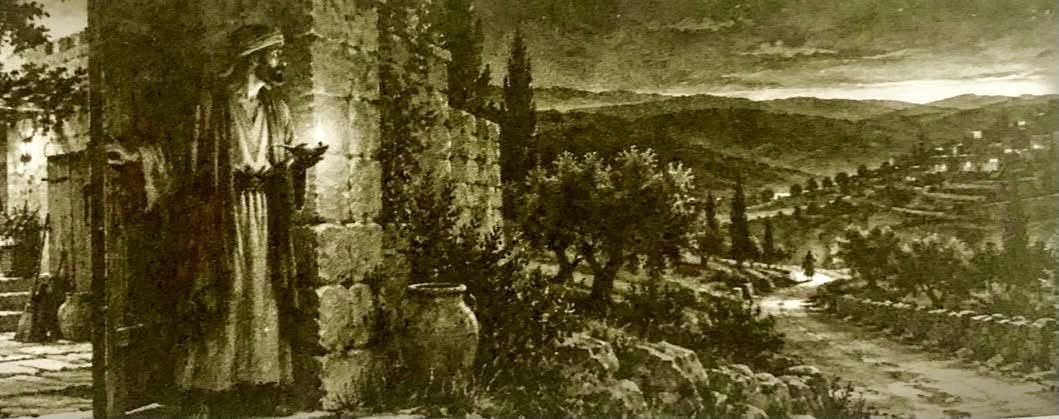
Referring to these events, Jesus says, “You do not know when the time will come.” Like the first and second readings, today’s Gospel points to God’s future intervention in human history, Christ’s second coming, though Jesus’ words also speak to other endings: the Temple, our lives, and the world. Because these events are certain but their timing is unknown, Jesus tells his disciples, “Be watchful! Be alert!” and “Watch!”
Today’s reading from the third section of Isaiah is a prayer for God’s inbreaking in history, a fitting first reading for Advent. It reminds us of our need for God and urges us to pray for God to come into our lives and world to save us. The gospel points Mark’s readers to the second coming, with assurance grounded in the word of Christ himself. They are to be ready. Paul tells the Corinthians that the best preparation for Christ’s return is to produce the fruits of holiness made possible by the action of God’s Spirit within them.
At the start of a new Church year, these words remind us to watch and pray always. We do not know when that time will come.
Amen!