442 total reads
Homily for Friday of the Second Week of Easter, 29 April 2022, Jn 6:1-15
How do you feed five thousand people with five loaves and two fish and get them satisfied, and still be able to collect 12 baskets full of leftovers? Of course if you stick to the mathematics of it the way the disciples did, it would seem impossible. And so when the five thousand are actually satisfied and twelve baskets of leftovers are actually collected, the tendency is to call it a miracle. John the evangelist was not fond of that word MIRACLE. In act he never uses it. What he prefers to use instead is the word SIGN.
I myself grew up in a huge family with six brothers and six sisters. We had meager resources but I never felt I was deprived of basic needs because we shared everything in common, not only our food but even our clothes and shoes. Yes, almost everything. We were never programmed to say MY room, my money, my cell phone. We had no cell phones yet back then. Even the closets in which we kept our clothes were common. And so when you look for your favorite t-shirt, it is not unusual to see your brother wearing it. No big deal, wear another.
When people hear that we all finished college and became professionals, they think it was because we were well-off. We were not. Was it a miracle then? No it was not. It just had to do with a shared lifestyle of sharing that we grew up with, and which we thought was learned in all families. I discovered only later that it was our real wealth.
Why do the five barley loaves and two fish shared by a little boy constitute a sign, according to the Gospel writer? What were they supposed to signify? In those days, bread made from barley was considered as the bread of the poor. People took it for granted that barley grain were fit only as food for horses, not for humans. And so John is emphasizing that the first ones to respond to the need for food were the poor. That gesture became the sign that started it all.
Making bread out of barley in a situation of poverty was not an unusual thing. Haven’t we heard that necessity is often the mother of invention? I am sure that principle applies also to food. We have many types of food that have been discovered or invented in a state of want or famine, or even during a calamity. Whoever thought that even the claws of chickens could be made into a delicacy and even be named adidas? Or the intestines barbecued and called PLDT? Or their embryos fried and called kwekwek? When did we start learning to eat the heart of a banana, or the core of a coconut tree, or young bamboo shoots? Or even grasshoppers and rice crickets called camaru by Kapampangans? I am sure the story is the same for Europeans when they learned to make something edible like yoghurt and cheese from spoiled milk.
The Eucharist has always been more than a commemorative meal for us Christians. No wonder Pope John Paul II once said, “The Church draws her life from the Eucharist.” The same verbs pronounced at the institution of the Eucharist are more than just a formula for consecration for us. They are a formula of life: he took the bread, blessed it (or gave thanks for it), broke it, and he gave it.
Perhaps this was the reason why John was not comfortable with the word miracle and preferred the word SIGN. The feeding of the multitude was indeed miraculous, but not in the magical or supernatural sense. Too bad if all we can see as miraculous is the multiplication of food. There is definitely some mathematics involved in this feeding story but it was not all about multiplication. Rather it began with a simple act of division. I mean division in the positive sense.
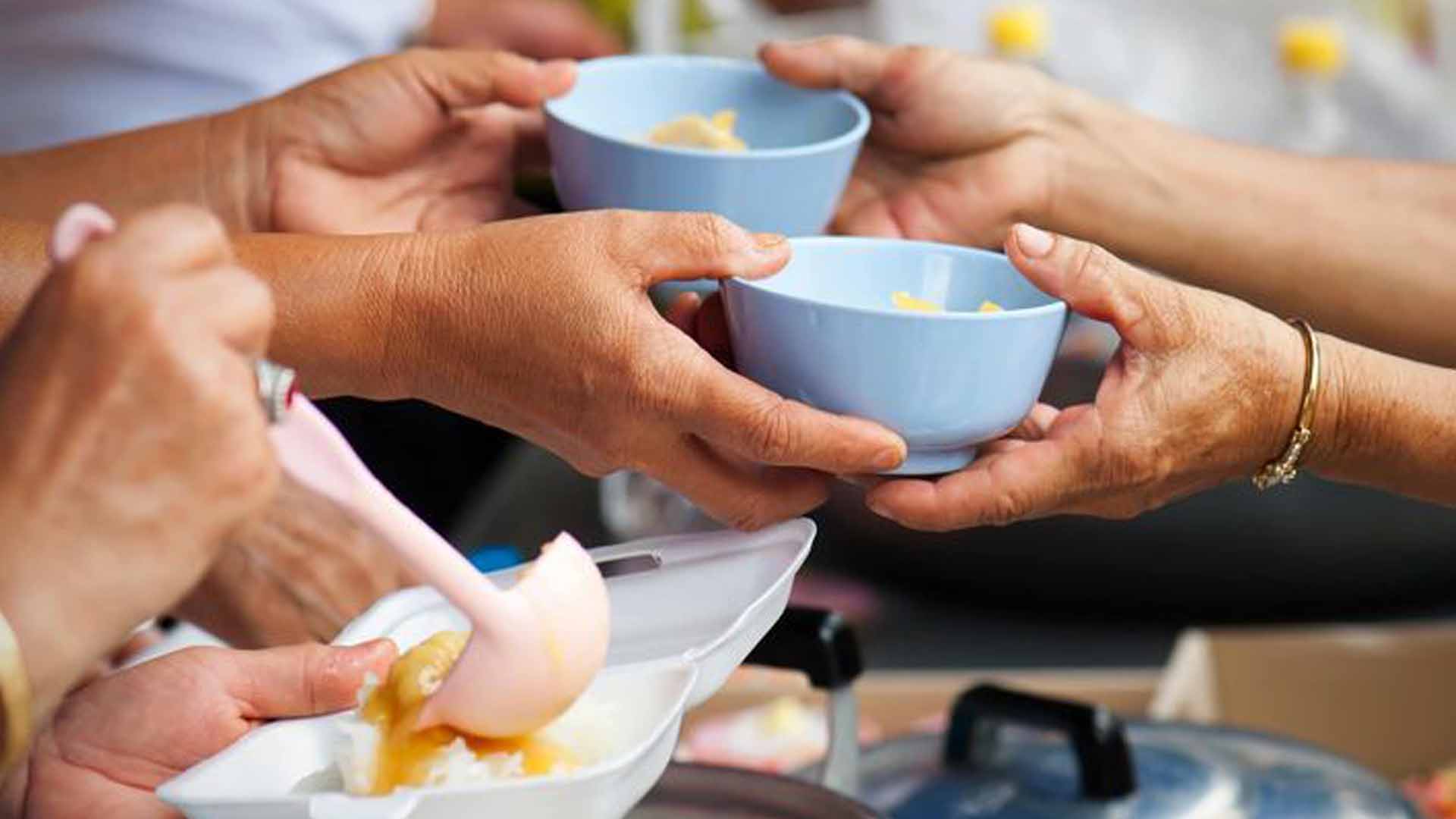
How do you feed five people for example with one loaf of bread? Simple. You break it. In Tagalog we call it hating kapatid. I have told you once about an African tribe that called the principle UBUNTU. Remember the reasoning of the kids who said, “Why will we try to get ahead of each other to get all the candies only for ourselves? How can we truly happy with the candies if the others are unhappy?” Ubuntu is I AM BECAUSE WE ARE.
How does the Eucharistic bread become a sign? When the act of dividing or breaking bread motivates many others to do the same and leads to more sharing that creates a state of abundance. Soon the division leads to a multiplication that is unstoppable, such that everyone gets satisfied and there are even lots of leftovers saved.
How does the Eucharistic bread become more than a sign? Namely, a sacrament? When Jesus takes, blessed, breaks and gives it and says THIS IS MY BODY. It is no longer just sign through which generosity breeds generosity. It becomes a sacrament of love and self-giving. The story of the bread taken, blessed, broken and shared becomes the story of life itself, the story of salvation.
In the series of actions related to the Eucharist, obviously the most challenging part is the BREAKING. It stands between the BLESSING AND THE GIVING. We are indeed gifted to give as the theme for the 5ooth YoC put it. We are blessed to be a blessing. But for that to happen, we have to be ready for the BREAKING. It what we call the paschal mystery in our Christian faith.