


646 total reads
I’ve just watched a video in French. A lady high school teacher proposed a hypothesis about the connection of the total school ban on cellphones to the high school students’ uprising in France. She made a lot of sense to me. She said:
“We have forgotten to discuss one element in this high school student mobilization—an element that is central to the lives of teenagers, and indeed to everyone’s lives: the mobile phone.”
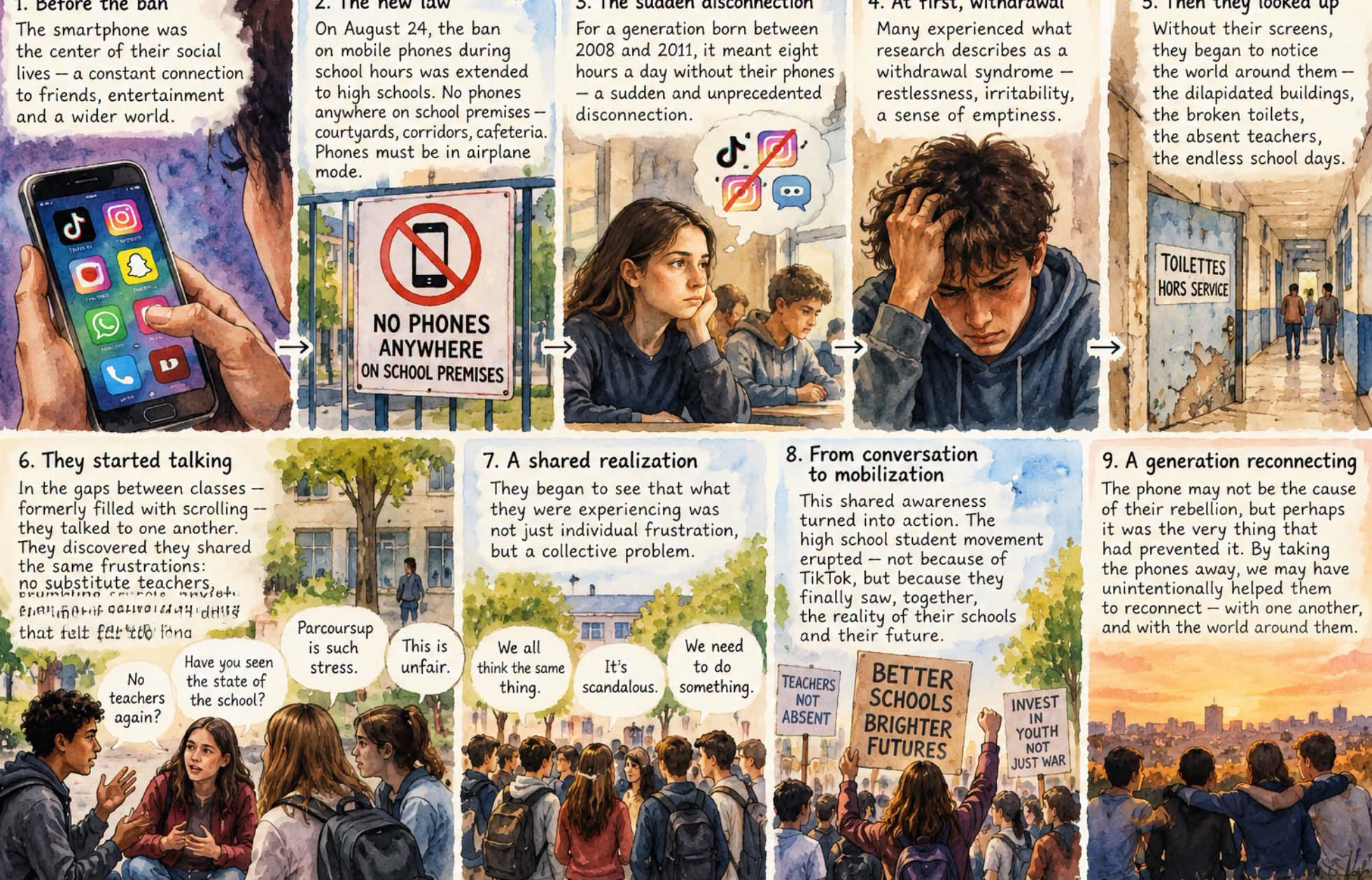
“The law of August 24 extended the ban on mobile phones during school hours to high schools. It is no longer simply a matter of ‘no phones during class.’ It has become ‘no phones anywhere on school premises’—not in the courtyard, not in the corridors, not in the cafeteria. Phones must be switched to airplane mode.”
“And then, just one month later, this high school student movement erupted, denouncing the shortage of substitute teachers, dilapidated school buildings, anxiety over Parcoursup—the university admissions system—and excessively long school days.
Coincidence? I don’t think so.”
“Now, I am not saying that mobile phones are the cause of the movement. And I am certainly not suggesting that students are setting garbage bins on fire because someone confiscated their TikTok. In fact, I am suggesting quite the opposite.”
“My hypothesis is that the mobile phone ban was the invisible trigger of this anger. What do I mean?”
“We know from scientific research what happens when adolescents who are heavily dependent on their smartphones are suddenly deprived of them. It resembles a withdrawal syndrome. And you don’t need to be a neurologist to understand this. Just observe what happens at home when you confiscate your teenager’s phone.”
“What fascinates me is the coincidence. We have just taken away from an entire generation the object around which they have organized practically their entire social lives.”
“Those born between 2008 and 2011 are the first generation to have been suddenly subjected to eight hours of disconnection every day—something that we adults would probably be quite incapable of imposing on ourselves.”
“And what did they do? They raised their heads. And they saw the condition of their schools. They noticed the filthy toilets, the absent teachers, the endless school days. The gaps in their class schedules suddenly became eternities without screens.”
“We wanted them to put down their phones. And they did. They started talking to one another between classes. And they discovered that they all agreed: what was happening around them was scandalous.”
“And this is precisely what a teacher from Seine-Saint-Denis describes this morning in an article published on the website Le Grand Continent:
“When my students lifted their eyes from their phones, they became noisy again. And they discovered that we had prepared an unbearable world for them.”
“And what if the mobile phone was not the instrument of their rebellion, but rather the very thing that had prevented that rebellion from happening earlier? That is my hypothesis. The high school students taking to the streets represent a generation that is beginning to reconnect with itself.”