
815 total reads
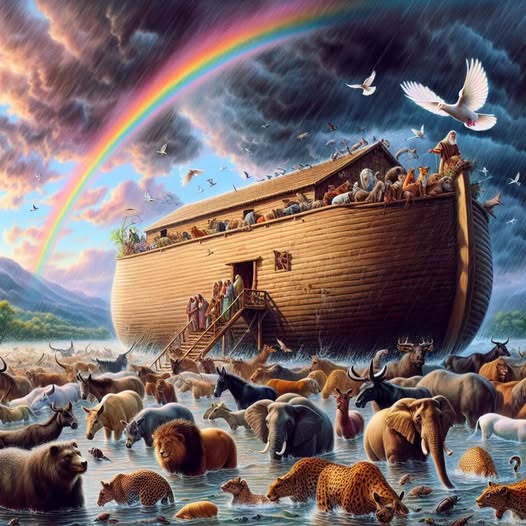
“When God saw how corrupt the earth had become, since all mortals had corrupted their ways on earth, God said to Noah… ‘Make yourself an ark… Of all living creatures you shall bring two of every kind into the ark… to keep them alive along with you… Moreover, you are to provide yourself with all the food that is to be eaten, and store it away.’”
— Genesis 6:12–14, 19–21
I have always been fascinated by this ancient biblical narrative about the Great Deluge. It is a tragic story, but also an extraordinarily hopeful one—a story about destruction and a new beginning.
It is tragic because Genesis dares to say that God “regretted” having created humankind. Human beings, who had been entrusted with the care of creation, had instead filled the earth with violence and corruption.
But it is hopeful because of Noah. Through one family, God gives humanity a chance to begin again. Noah becomes, as it were, the seed of a new humanity after the flood—still sinful, still fallible, but nevertheless graced and entrusted once again with the care of the earth.
What fascinates me even more is that Noah is commanded to save not only human beings but the other creatures as well. The ark is meant to preserve the diversity of life. And although the biblical narrator does not mention it, I sometimes imagine Noah also gathering seeds—seeds of trees, grains, vegetables, herbs and flowers—because animals cannot survive for long on an earth without plants.
In fact, modern science has already been building its own versions of Noah’s Ark.
High in the Norwegian Arctic is the Svalbard Global Seed Vault, where more than 1.4 million seed samples from gene banks around the world are now kept in secure storage—an enormous backup collection intended to safeguard the genetic diversity of the crops on which humanity depends.
In England, the Millennium Seed Bank at Kew safeguards more than 2.5 billion seeds representing over 40,000 wild plant species. Kew itself has called it a “Noah’s Ark for plants.”
And for the animals there is the Frozen Ark, which preserves tissues, cells and DNA from endangered species before their genetic heritage is lost forever.
These are not science-fiction projects. They already exist. Scientists are quietly storing the biological memory of the earth—seeds, cells, tissues and DNA—so that species threatened with extinction might still have a future.
There is something both reassuring and disturbing about this.
Reassuring, because human beings are capable of foresight. We can anticipate catastrophe. We can preserve. We can protect. We can prepare for a restart.
But disturbing because we have to ask: Why are we finding it necessary to build modern Noah’s Arks in the first place?
The biblical flood was blamed on human corruption and violence. The ecological disasters confronting us today—climate change, melting glaciers, rising seas, deforestation, collapsing ecosystems and accelerating extinction—are also, to a significant degree, consequences of human activity.
Perhaps the deeper message of Noah’s Ark for our generation is therefore not: Prepare an ark because destruction is inevitable.
It is: Change our ways while there is still time.
As we prepare to celebrate Creation Sunday on September 6, perhaps Noah is inviting us to rediscover what it means to be human: not owners of creation, free to exploit it until there is nothing left, but stewards entrusted with keeping life alive.
The ark, after all, was not built for Noah alone. It was built for the whole community of life.