

932 total reads
Homily for Tuesday of the 9th Wk in Ordinary Time, 6 June 2023, Mk 12:13-17
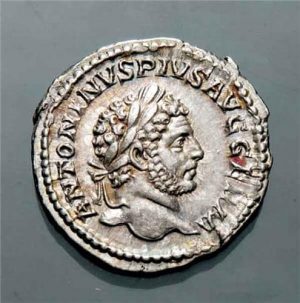
“Is it lawful to pay taxes to the Roman government? Should we or should we not pay?” This was how the question was posed to Jesus by two opposing groups: by the Herodians, on the one hand, who were in favor of paying, and the Pharisees, on the one hand, who opposed it; they did so on the basis of the Law of Moses. Mark tells us they were both actually doing this to ensnare Jesus. They were obviously trying to put him on the spot. But his unexpected answer would turn the table upside down; it would put them on the spot instead. In English, they’d say, “He pulled the rug from under their feet.” How? By answering their question with a question.
First, he asked them to bring him a Roman coin; and then he posed this question, “Whose image and inscription do you see on this coin?” Of course, the Roman emperor’s.
Jesus knew his history. He knew that it was only within his lifetime that the Roman currency replaced the local currency in the province of Judea. This happened after Rome deposed the local governor of Judea, Archelaus, and replaced him with the Roman Prefect, Pontius Pilate. By doing this, Rome in effect had turned Judea into a Roman province. That was not yet the case with Galilee, the home province of Jesus, which had Antipas, the son of Herod, a Jew, as governor.
Jesus also knew that an earlier revolt had been declared by a leader called Judas the Galilean, whose followers had vandalized the Roman coin by stamping on the emperor’s face an image of a palm branch. They did this mainly to make a statement: “We have no king but Yahweh! We will not submit to Roman rule.” If Jesus had answered this way, he would have been immediately charged of the crime of sedition.
But, like I earlier said, he answered their question with a question that turned the table upside down. He had done this literally in chapter 11, when he overturned the tables of the money changers; now he’s doing it figuratively, by asking: “Whose image is on this coin?” Of course—the Roman emperor’s. And yes, using his currency means they had already submitted themselves to Roman rule. It was his way of asking them, “What are you ranting about?” Then he drops the famous line, “Render to Caesar what is to Caesar, and to God what is to God.” Meaning— “If you’ve already submitted yourselves to Roman rule, then you are obviously bound by Roman law to pay taxes to the Roman Government.” If not, then “render to God what is to God,” —that is, if they sincerely believed that Judea belonged only to God, not to the Romans, as the Pharisees would have insisted upon. Each line was hypothetical or conditional: “If you accept Roman rule, you have no choice but pay Roman taxes. If not, then don’t pay. But don’t go arround using the Roman currency if you do not want to submit to the Roman government.”
Of course we know how this line from Jesus would later be used as a Bibical argument in favor of the principle of separation of Church and State—which was obviously not in the mind of Jesus. If you were to ask Jesus the same question today, “Should we or should we not pay taxes to the Philippine government?” he’d probably answer again with a question, “What does your constitution tell you about it?”
Isn’t it obvious, following the Constitution that taxpayers’ money is to be used only for the public welfare and the common good? While it is unlawful not to pay taxes, it is equally unlawful for politicians and public servants to turn public funds into their personal funds. He would probably tell Filipinos today, “Give your government what your government is worth, and give to God what rightfully belongs to God—namely, your full commitment to the common good.”