
5,678 total reads
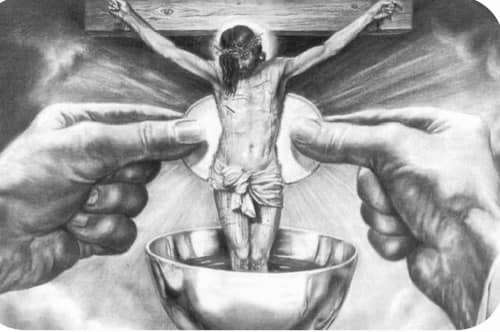
The word Eucharist is the direct translation of the noun ‘eucharistia’ ( εὐχαριστία ) and is primarily an expression of gratitude to God (especially in the letters of St. Paul, e.g. 2Cor 4:15, 9:11,12), and in particular as thanksgiving to God in worship, (cf 1Cor 14:16; Rev 4:9,7:2). But what could allude to the Eucharist as celebrated today is the verbal form of the word (‘eucharisteō’) found in the narrative of the institution of the Eucharist: 1 Cor 11:23-25; Mt 26: 26-29; Mk 14: 22-25; Lk 22:17-20, where Jesus “gave thanks”. John is silent about the institution but his discourse on the Bread of Life in Chapter 6, especially vv. 51-58 is clearly Eucharistic.
Jesus chose the precise time of the Passover, (the feast when the Jews remember the saving acts of God and thank him for his gratuitous covenant with them as his people), to institute the Holy Eucharist. At the Last Supper, he took bread and wine, declaring them his Body and Blood, and anticipated his death on the Cross, his passing over to the Father. It is the New Passover. Other vocabularies in the institution spoken by Jesus confirmed it- ‘broken’, ‘body given’, ‘blood poured out or shed for’, ‘the remission of sins’. Jesus is indeed the high priest and mediator of the new covenant who by his own blood performed the rite of purification and given us access to God, (cf. Heb 9:11-15; cf s1S#34 Thanks, 06/06/21).
By partaking in the Body and Blood of Christ, we share in the New Passover of Christ. We pass over from sin to grace, from death to life. As we celebrate this feast of the wonderful sacrament he left us as a memorial of his passion, let us continue to receive him worthily that we may experience the fruits of his redemption and be nourished by the bread that gives eternal life and be able to make his presence be felt through our own self-giving for others. And let us pray:
“Soul of Christ, sanctify me.
Body of Christ, save me.
Blood of Christ, inebriate me.
Water from the side of Christ, wash me. Passion of Christ, strengthen me…Amen.”
Fragments
The Eucharistic tradition in the church is one of the oldest and most well-documented beliefs. By the year 50 AD it was fixed in the life of the church and the death of Jesus was being memorialized. Thus 1 Cor 11:23-25 is considered the earliest version of the Eucharistic formula in the New Testament, (cf Mt 26: 26-29; Mk 14: 22-25; Lk 22:17-20). Multiple NT witnesses, as diverse they may be, all coverage around this central belief.
The symbolism of the bread as food took a profound theological significance when Jesus claims to be the ‘bread of life’, in the gospel of John chapter 6. As God’s provision from heaven, it meets humankind’s deepest spiritual need for reconciliation with God and intimate fellowship with him, fulfilling the spiritual significance of the manna given by his Father to the Israelites (vv48-51). And in the breaking of the bread of the Passover meal with his disciples, prefigures his broken body that hung on the cross, signifying his agony and suffering that brought life and salvation to mankind and partaking of it symbolizes the unity of Christians in one bread and one body, (cf 1 Cor 10:16ff, 11:23ff).
In the Lucan narrative of the multiplication of the loaves (9:11-17), the Eucharistic motif is strongly imprinted. Although there is mention of both loaves and fish, it is the bread that is, predominant even in the collection of the “fragments”, klasmata, (κλασμάτα) v17. This term became the technical expression for the Eucharistic bread. Thus the “breaking of the bread” is used before it is referred to as the Eucharist, (cf Acts 2:46). The action of Jesus in ‘taking, blessing, breaking, and giving’ (v16), reproduces almost exactly the Last Supper formula (22:19), and the Emmaus meal (24:230). In the church Jesus continues to feed and nourish his followers through the ministry of the apostles (it was the apostles who distributed them, v16), and eventually their successors in the sacramental celebration of his saving death.
As we celebrate the Solemnity of the Most Holy Body and Blood of Christ let us thank the Lord who gives himself in the Eucharist for our salvation and ask him that we may truly experience his real presence every moment of our lives and may we become ‘blessed fragments of bread’ to others as we offer our selves to them in service and love. Amen.