11,632 total reads
Isa 9:1-6
The reading belongs to that section of the book of the prophet which is called the “book of Emmanuel” which deals with prophesies about the coming Messiah whose coming is pictured as light to those in darkness, a king bringing salvation to his people.
Eph. 1:3-6, 15-18
The prophecies about God’s plan is fulfilled in Christ. God has blessed us in Christ “with every spiritual blessing.” He chose us to be “holy and without blemish” (vv. 3-4). In love, he chose us for adoption, as he willed. We praise him for the grace “that he granted us in the beloved,” Jesus his Son (vv. 3-6).
Mt. 18:1-5, 10
The Apostles ask Jesus, “Who is the greatest in the kingdom of heaven?” (v. 1). He places a child in their midst and teaches them, “Amen, I say to you, unless you turn and become like children, you will not enter the kingdom of heaven. Whoever humbles himself like this child is the greatest in the kingdom of heaven” (vv. 3-4). “And whoever receives one child such as this in my name receives me” (v. 5). “See that you do not despise one of these little ones, for I say to you that their angels in heaven always look upon them”.
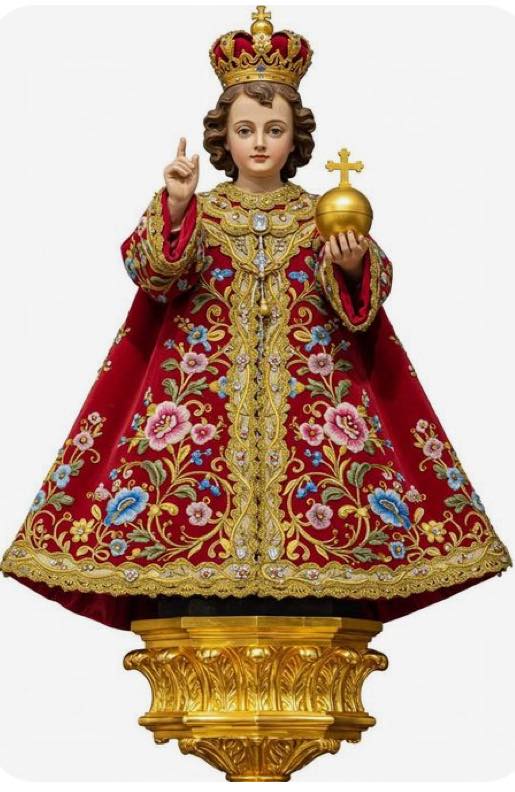
The theme of our celebration today is the gift of the God-Child who illuminates the darkness of our lives. Through him, we have received the riches of the Father’s blessings. We have been made the Father’s adopted children. That is the objective faith-reality, received at our Baptism. But subjectively, we have to become what we are – the innocent, trusting, obedient child in today’s Gospel, in order to enter the kingdom of heaven. Amen!
Pit Señor!
Historical Notes:
Filipinos have maintained a long tradition of venerating the Sto Niño. Pope Innocent XIII approved special liturgical texts for a special feast to honor the Child Jesus on the 3rd Sunday of January.
Along with Magellan’s Cross, the Sto. Niño de Cebu is the oldest surviving Christian artifact in the Philippines. It was a baptismal gift of Ferdinand Magellan to Rajah Humabon (Carlos) and his wife, Humamay (Juana) in 1521. It is made of dark wood, depicting the Child Jesus, about 12 inches high, in Spanish imperial robes, a golden crown, and a scepter.
In 1565, Miguel Lopez de Legaspi burned Cebu when his efforts at peaceful colonization were rejected. In the ruins of the destruction, a Spanish mariner found the image of the Sto. Niño in a pine box. Ever since its rediscovery (“Kaplag”), the icon is believed to be miraculous. It is one of the most beloved cultural and religious icons in the country.
St. John Paul II recalled this history when celebrating a Mass for families in 1981 in Cebu City: “God’s providence in the Philippines has been truly wonderful. The Christianization that took place in the sixteenth century was not something merely accidental. Divine grace was at work when the people of this region had their first contact with the image of the Santo Niño. It is an important historical fact, rich in religious meaning, that on January 1, 1571, the village kingdom of Sugbu was renamed the “Villa del Santo Niño”, and thus the first city of the Philippines was placed under the patronage of the Child Jesus.
The feast of the Sto. Niño being inextricably linked to the child Jesus confirms that the country has the longest celebration of Christmas.