


13,393 total reads
19th Sunday A
1 Kgs 19:9, 11-13
Elijah, a key figure in covenant renewal, reenacts the exodus journey. His life threatened (v2), he embarks on a forty-day desert trip, echoing Moses’ time on Sinai (Ex 34:28) and Israel’s forty years in the desert (v8). He reaches Horeb, known as Sinai in certain traditions. Like Israel (Ex 16), he’s sustained miraculously (vv6ff). This exodus motif sets the stage for his encounter with Yahweh after taking refuge on Horeb (v9). During Moses’ stay, he glimpsed God’s nature (Ex 34:5ff), a parallel to Elijah’s experience. In both, the Lord ‘passes by’ (v11; Ex 34:6). Unlike the stormy Sinai theophany (Ex 19:16-19), Elijah’s encounter involves wind, earthquake, fire—yet God isn’t in them. Instead, there’s a tiny whispering sound (Heb: qol demamah daggah; ‘the sound of a fine silence,’ v12). This paradoxical silence hints at God’s transcendent, inexplicable presence. Elijah perceives this quiet, awesome presence and, like Moses, covers his face (v13; Ex 3:6).
Rom 11:13-15, 29-32
The reading begins Paul’s discussion on the role of Jews and Gentiles in salvation (chs. 9-11). He laments that his fellow Jews haven’t accepted Christ as Messiah and Lord. In Christ (v1): His truth is linked to his life in Christ through the Spirit (2 Cor 11:31). Conscience and the Holy Spirit attest to his honesty. Paul is willing to sacrifice his spiritual life for his fellow Jews, like Moses (Ex 32:32). He lists eight ways Jews are connected to God: 1. Israelites, a honorific from Jacob (Gen 32:29). 2. Adoption as God’s children (Ex 4:22; 19:5f). 3. God’s glory in the theophany and temple (Ex 16:10; 40:34). 4. Covenants with Noah, Abraham, Moses (Gen 9:8; 15:18; Ex 24:7f). 5. Worship of Yahweh with divinely set norms. 6. Promises of God’s presence to the patriarchs (Gen 12:2). 7. The patriarchs—Abraham, Isaac, Jacob—honored in prayer and blessing. 8. Christ as the culmination of Jewish identity; from Jerusalem, the Messiah, Christ the Lord (v5). The punctuation varies across manuscripts, affecting the verse’s flow, either balancing human and divine origins or emphasizing God alone to be blessed.
Mt 14:22-33
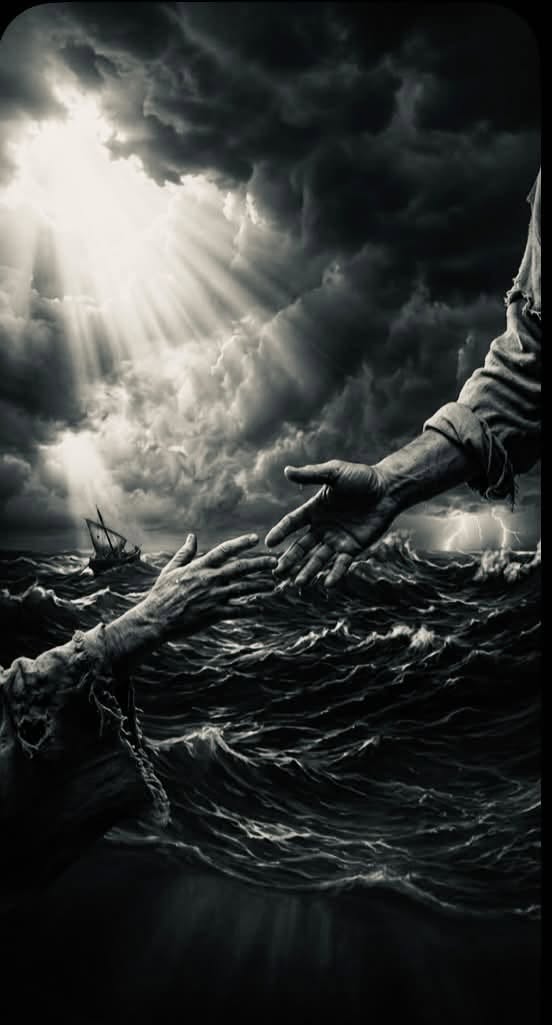
Earlier in the gospel of Matthew it was narrated that Jesus and his disciples were on the boat when a violent storm broke. Jesus was asleep and has to be wakened up, (8:23-27). In today’s Gospel, Jesus, while at prayer and not with the disciples, a strong headwind raises high and batters the boat, (14:22-32). Though most of the disciples were very familiar with the sea, no one among them was capable of predicting the storms that broke out unexpectedly. Both stories reflect the first-century belief in spirits, including wind spirits, that play havoc with human life. And only the one who has the power to control them can counter it. Thus, the story comes out not only as a nature miracle (v32; 9:23-27) but more so as an epiphany, a manifestation of the identity of Jesus and his salvific mission, (v30f).
As an epiphany, it means Jesus does what God does: stilling the storm (Ps 107:29), walking on the sea (vv 25, 26, the phrase repeated to emphasize the fact that Jesus does something unusual that only God does; cf Job 9:8), and rescuing those in danger of drowning (Ps 69:1-2, 15; 144:7; Jonah 2); and Jesus speaks as God does: “It is I”, (Is 41:4, 43:10; the expression appearing several times alongside the phrase “fear not”, identifying Jesus as the one who reveals the God of Israel and is uniquely related to that God; cf Ex 3:14; Dt 32:39).
Before this epiphany, the disciples, and in particular Peter fall short in their perception of who really Jesus is. Jesus addresses Peter with the characteristic expression used in Matthew to describe The Twelve, (Mt 6:30, 8:26, 16:8, 17:20). The term “oligopistos” ( ὀλιγόπιστος ), is a word combined from two words, “oligo” meaning small or little, and “pistos”, belief or faith, thus, the adjective of having little faith. In other words, it connotes lacking in belief or having faith in the person of Christ. In both stories, the disciples wavered in their faith. When Jesus comes to the disciples tossed about by the storm and still the sea it shows he really shares that power with God with whom he is in constant connection through his prayer (v23). And it would have been the same for Peter if only he remain focused on, and had enough faith in, Jesus.
Amid the turmoil, it is clearly the abiding presence of Christ that saves. He is the Lord (vv28, 30). And we, like Peter and the rest of the disciples, though we may believe in Him, at times do falter, or have “little faith”, especially in the face of persecution and opposition, obstacles and difficulties. May we always keep our eyes fixed on Jesus in the storms of life and may we not lose our courage or faith and always remember that He is close to us, ready to grab our hand (and save us) when we start to sink. We have only to pray: “Lord save us”. Amen!