


200 total reads
30th Sunday A
Ex 22:20–26
This covenant law protects three vulnerable groups: resident aliens, fatherless families, and needy borrowers. Aliens (Heb: gerim) were non-Israelites living in the country. Though distinct and without equal status (Ex 20:10), they were entitled to fair treatment and concern (23:9; Lev 19:33; Deut 24:17). They are often named alongside widows and orphans, who, lacking male providers, depended on the community. Yahweh promised them special protection, guaranteeing their rights (Is 1:17). Without land or clan protection, aliens shared a status like that of widows and orphans (Jer 7:6). The law forbids mistreating these groups (vv20ff). Israel’s own experience as “displaced persons” in Egypt grounds its duty to treat aliens fairly (v20). Yahweh himself defends widows and orphans, who have no male protector. As in the covenant code (21:23ff), punishment matches the offense: the guilty person will die, leaving his own wife and children vulnerable.
The next section addresses hardship within Israel (vv24ff). Loans to needy Israelites must be interest-free, since interest would worsen their disadvantage. The law does not prohibit interest on loans to wealthy or landed people, or to aliens, though this rule appears to have changed over time (Deut 23:20tt). Lenders commonly accepted pledges as security, but humanitarian limits applied. A large cloak (v25), often a poor person’s nighttime blanket, had to be returned by evening if pledged. Yahweh’s compassion sets the standard (v26). These early laws show a clear concern for human welfare.
1 Thes 1:5–10
Today’s reading highlights two Pauline themes: modeling and conversion. Paul sees his life as integral to his mission: he imitates Christ (1 Cor 11:1), especially in sharing his suffering (Col 1:24). As the Thessalonians suffer for the gospel, they imitate Paul (v. 6; 2 Thes 3:9). Their combination of affliction and joy unites them with Christ through “fellowship in his suffering” and the Spirit-filled “power of his resur-rection” (Phil 3:10). They, in turn, become examples for other Christians (v. 7), just as Judean churches modeled endurance (2:14). Their conversion demonstrates God’s word so clearly that Paul need add nothing (v. 😎.
The second theme is conversion (vv. 9–10). Other churches report that the Thessalonians have “turned to God,” an early expression of Christian metanoia. The Hebrew idea, shub, means a complete turnabout. Hearing God’s word, they turned from their gods to the one God.
Idols (v. 9) were images believed to embody or host deities. Paul calls them empty “no gods” (1 Cor 8:4f). Turning from these idols—the sinful extreme—means committing to the “living” and “true” God: living, unlike dead pagan gods, and true because faithful to his promises. Through this Spirit-led turnabout, the Thessalonians became models for other churches.
The passage ends with urgency about the Lord’s return. Jesus, raised as Son of God (v. 10; Rom 1:4), will return as Son of Man to deliver the just from the final tribulation.
Mt 22:34–40
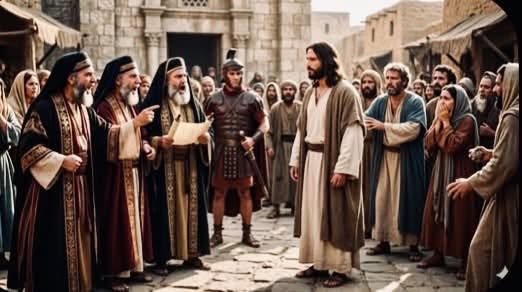
Jesus’ teaching on the greatest commandment appears in all three Synoptic Gospels (Mk 12:28–34; Lk 10:25–28). It illuminates the New Testament’s view of Jewish law and shows how Jesus’ teaching surpassed the Pharisees’ extensive legislation and casuistry. Mentioning the Pharisees and Sadducees (v. 34) links this passage to the preceding dispute with the Sadducees (22:23–33).
A lawyer approaches Jesus (v. 35). Though Matthew does not use “lawyer” elsewhere for a “scribe,” both terms refer to someone skilled in the Hebrew Torah. The question (v. 36) is a genuine challenge, posed to test Jesus. With more than six hundred commandments, Jews needed to determine their relative importance.
Jesus’ response combines two separate Hebrew-scripture verses (vv. 37ff). His quotation from the Shema (Deut 6:4f), a sacred ethical precept and affirmation of monotheism, is uncontroversial. Loving God requires commitment of will (heart), life (soul), and mind. Matthew replaces Deuteronomy’s and Mark’s “strength” with “mind,” associating it with the heart, understood in Hebrew thought as the seat of knowledge and will rather than emotion. Love of God thus demands total covenantal fidelity, without competing loyalties.
Jewish teaching linked love of God and neighbor, but Jesus makes the connection inseparable, pairing two verses not previously joined. His quotation from Leviticus (19:18), initially referring to fellow Israelites, becomes central to his teaching (Mt 19:19) and later epistolary writings (Rom 13:8–10; Gal 5:14; Jas 2:8). Jesus extends “neighbor” beyond ethnic and national boundaries, both to those treated as neighbors (Lk 17:11–19) and those who act as neighbors (Lk 10:29–37). Comparing love of neighbor with love of self also affirms legitimate self-love within Christianity.
Jesus moves beyond the questioner’s narrow legal perspective: love of God and neighbor is the overarching principle by which all other laws are embraced and judged. Rather than treating one commandment as simply the greatest, he says that all Scripture—the Law and the Prophets—must be interpreted through it (v. 40), giving the law of love supreme importance.
The commandment of love is an inspiring and challenging summary of what it means to be a Christian. There is no aspect of human conduct that it does not embrace. May our love of God and our neighbor remain inseparable. Amen.