

4,492 total reads
Lk 22:14 – 23:56 (before the procession)
The reading highlights Jesus’ entry into Jerusalem as the culmination of a journey that began earlier in the gospel (9:51). This journey signifies both a geographical and spiritual ascent, leading to his transition from death to glory. Jesus’ choice of a young donkey (vv30-34) signifies his foreknowledge and control over his destiny, emphasizing his humble kingship, as referenced in Zechariah (Zech 9:9).
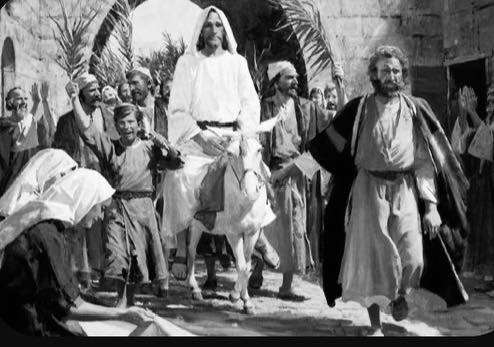
In the procession, the cloaks laid before Jesus symbolize renunciation (vv35f). The crowd praises God and Jesus as king (vv37ff), recalling his mighty deeds and referencing Psalm 118:26 to affirm his role as the promised one who will bring peace between God and humanity through his self-offering and glory to God.
Is 50:4-7
In Deutero-Isaiah, the servant of the Lord is mentioned four times. The first instance (42:1-4) describes his call, while the second (49:1-7) reveals opposition to his work. The third song (50:4-7) shows the servant being reviled, and the final song (52:13-53:12) clarifies that his mission involves both suffering and preaching. His prophetic role offers consolation to the needy (v4), particularly the faint-hearted. Despite enduring physical and mental abuse, including being struck and spat upon, the servant remains resolute (v7) and embodies the great prophetic tradition (Jer 1:8, 18; Ez 3:8f). The servant is not specifically identified in the Hebrew scriptures but is seen by New Testament writers as a foreshadowing of Jesus.
Phil 2:6-11
The Philippians hymn, is considered an early Christian poem that Paul likely included, with a potential addition of his own. This hymn, while raising various theological questions, underscores mutual concern and humility within the Christian community, encouraging the Philippians to align their mindset with that of Christ (v5).
The hymn can be divided into two sections: the first (vv6-8) describes Christ’s transition from divine form to human suffering and obedient death, highlighting his humility. In contrast, the second section (vv9-11) emphasizes his exaltation, showing his recognition as Lord after experiencing a humiliating death. The term “form” (Gr: morphe), indicating Christ’s divine essence, is contrasted with his appearance as a slave (v7), exemplifying his total self-surrender.
This obedience culminated in a death on the cross (v8), depicting ultimate abasement. In the second part, God elevates Christ, conferring upon him the title of “Lord,” reflecting universal acknowledgment akin to that of Yahweh in Isaiah (45:23). Ultimately, this hymn illustrates Christ’s unique role in God’s design for creation’s restoration, revealing his glory (Gr: doxa).
Luke 19:28-40
The Lukan narrative of Jesus’ passion reflects a deeper understanding of his identity as the Son of Man and Savior. Jesus speaks ambiguously about titles like “Christ” and “Son of God,” highlighting their dual truth and irony, especially in the context of the crucifixion. He emphasizes his mission to save others, which paradoxically requires him to not save himself.
Luke’s portrayal of Jesus is marked by his foreknowledge and control over events, showcasing him as a prophetic figure who initiates the final era. Throughout the passion narrative, Jesus maintains composure, teaching his disciples and emphasizing themes of humility and service. Notably, Jesus prays in the garden, and even in his arrest and trial, he exhibits restraint and forgiveness.
The centurion recognizes Jesus as a righteous man, affirming his life aligned with God’s will. The presence of other characters, like the apostles, reflects a more positive light on their actions within the story, contrasting with their portrayal in other gospels. Through this narrative, Luke emphasizes the importance of Jesus’ teachings and his mission of salvation up to the cross.
As we begin the celebration of Holy Week, let us accompany Jesus on his journey to Jerusalem. He, whom God has presented as an example of humility for us to follow, took on human flesh and submitted to the Cross. May we all heed his lesson of patient suffering and thus merit a share in his Resurrection. Amen.
The celebration of the Holy Week begins with Palm Sunday and ends with Easter Sunday. Called Palm Sunday because of the entry of Jesus to Jerusalem where he was greeted by the crowd waving palm branches. “…the entry of Jesus in Jerusalem must have been an impressive sight. The excited crowds lined the street, waving palm branches and shouting Hosanna! Roman soldiers always on the alert looked on suspiciously. And suddenly from the top of the Mount of Olives, the Messiah appeared! But to the surprise of some, they wonder why Jesus was riding a donkey. Even His disciples were puzzled and did not understand his transportation choice (cf. John 12:16)…It was a symbol of peace and humility. Abraham and Jacob both rode donkeys. The kings of Israel would ride a white donkey (Jgs 5:10). While horses were ridden during times of war, rulers rode donkeys during times of peace as a sign of humility toward the people (cf.1 Kgs 1:33-40). And so with the expected messianic king: “Say to daughter Zion, see your savior comes”, (Is 62:11); “your king is coming to you, a just savior is he, humble, and riding on a donkey, on a colt, the foal of a donkey, (Zec 9:9). Thus Jesus, the Messianic King, entered his royal capital of Jerusalem riding a colt…
“põlos ( πῶλος ), refers to a young and untrained donkey, (Lk 19:30ff; Mt 21:2ff; Mk 11:2ff). Normally, it would be difficult for someone to ride an unbroken animal through a crowded and chaotic scene with an unfamiliar burden on its back, yet in antiquity it is the right of a king to ride on which no one yet had sat. And by choosing a lowly young donkey, Jesus made a statement about the kind of his messiahship reassuring the city of Jerusalem that his kingship would be one of humility, peace, and salvation. While most royal processions feature incredible extravagance, he humbly entered the city on a colt exemplifying the peaceful return of a king to Jerusalem. He came to bring grace and not judgment, he came not to subdue or conquer but to save. In fact, by his action, he avoided the weapons of war like the horse, which was a military animal, ridden by foreign kings coming to conquer Israel…. By choosing a donkey, Jesus sought to let everyone know that he was building not on violence; he was not instigating a military revolt against Rome. His power is of another kind: “It is in God’s poverty, God’s peace, that he identifies the only power that can redeem”, (Pope Benedict XVI). Jesus’ coming on a donkey, to the accolades and praise of the gathered crowd, fulfilled indeed the OT prophecies about Jesus as Messiah King. He comes without pomp or ostentation: “He will not cry out or shout nor make his voice heard in the street”, (Is 42:2). He will be meek and humble, and he will make his entry in simplicity and poverty…” (cf s1S#24 Donkey, 03/28/21).
It is also called Passion Sunday when the whole passion narrative is read serving as an overture to the whole week’s celebration…” the passion story of Jesus is the oldest part of the Christian tradition to be preserved. From the earliest tradition reported by Paul where there were no details about Jesus’ suffering and death (1 Cor 15:3b-8), a short narrative of Jesus’ passion developed- he was arrested, tried, and crucified when the first generation of Christians began to die…
The verb ‘paschō’ (πάσχω) generally means ‘to endure suffering both physical and psychological torment’. Specifically, it refers to the suffering borne by Christ, st, (cf Mk 8:31, 9:12; Mt 16:21, 17:12; Lk 8:22, 17:25, 22:15; Acts 1:3, 17:3; Heb 2:18, 5:8; 1 Pt 2:21). By the time the evangelist began to compose their works, two major developments of the longer story of Jesus’ passion had evolved: first is characterized by fulfillment theme, namely that of Mark and Matthew; second, featured more dialogue and words of Jesus found in Luke and John (who omits the institution of the Eucharist but devoted four chapters containing more of his teachings)…Jesus, indeed, experienced all the ignominious events (betrayal, false accusations, torture, and the like) and died a shameful death, one reserved for the worst of criminals. But Matthew showed that Jesus is the master of his fate throughout. He knows that he is in the right, trusting that God will vindicate him… (cf s1S#131 Passion 4/2/23).
This is what is celebrated this Holy Week, his Paschal Mystery. This mystery (acc. CCC #571)”stands at the center of the Christian faith because God’s saving plan was accomplished once and for all by the redemptive death of Jesus himself”. By his death, Christ liberates all from sin; by his Resurrection, he opens the way to new life. All are justified. All are saved and truly share now the very life of God.
Let us accompany Jesus as he hastens toward Jerusalem, and imitate those who met him then, not by covering his path with garments, olive branches, or palms, which delight the eye for a few hours and then wither, but by doing all we can to prostrate ourselves before him by being humble and trying to live as he would wish, taking up our own cross daily so that we may partake of his everlasting kingdom. Amen!