


551 total reads
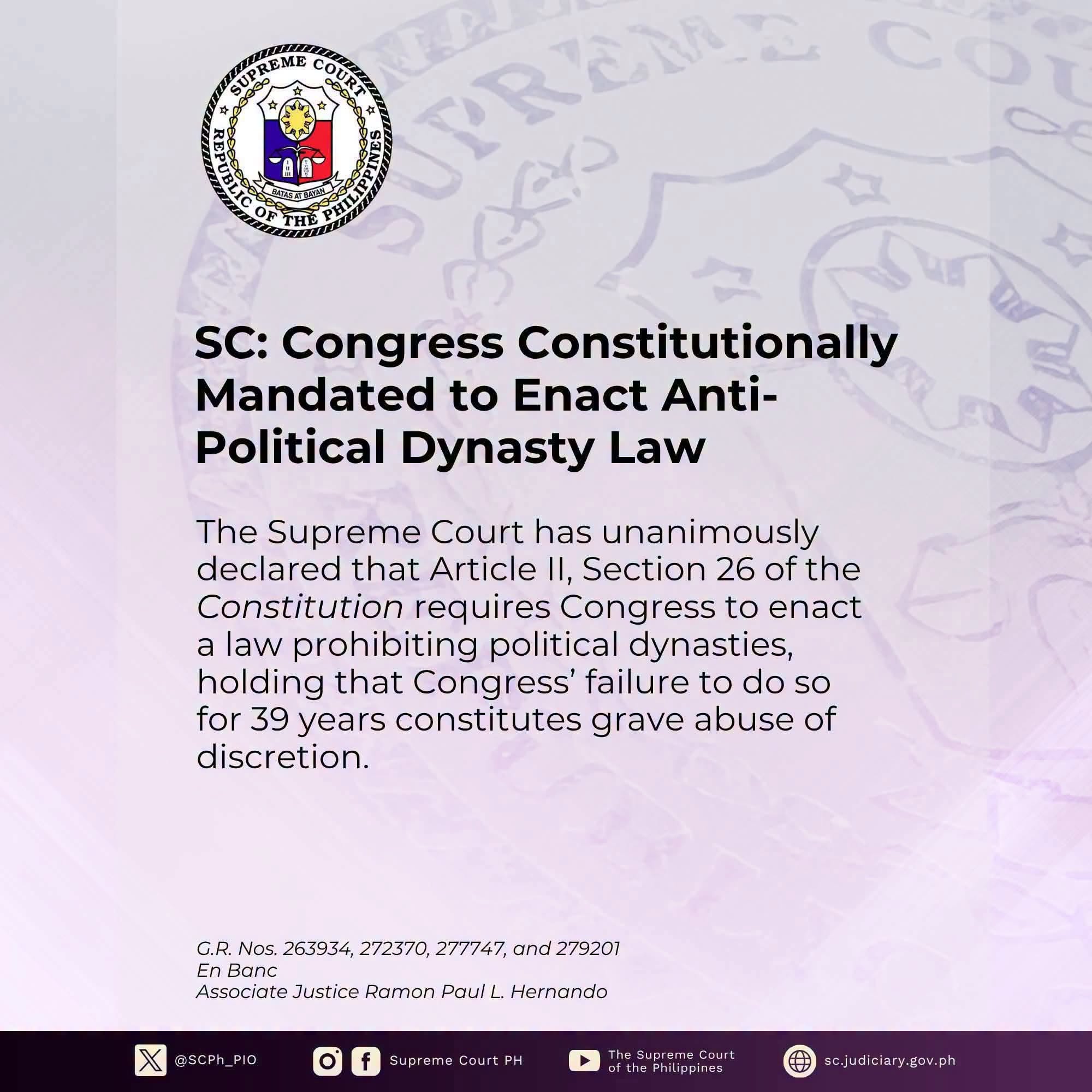
Thirty-nine years. That is how long Congress has failed to enact the law required by the 1987 Constitution to prohibit political dynasties.
Today the Supreme Court finally said: enough.
In a unanimous decision, the Court declared that Congress has a mandatory constitutional duty to enact an anti-political dynasty law, and that its prolonged failure to do so constitutes “grave abuse of discretion” and a continuing violation of its constitutional duty. The Court directed Congress to act “with utmost urgency” and enact the law “at the earliest opportunity.”
Those are exceptionally strong words.
Article II, Section 26 of our Constitution declares: “The State shall guarantee equal access to opportunities for public service, and prohibit political dynasties as may be defined by law.”
For almost four decades, the constitutional command remained largely unrealized because Congress itself was entrusted with defining what constitutes a political dynasty. The Court noted that dynasties have meanwhile remained widespread, extending even into the party-list system.
Perhaps this ruling raises a question larger than political dynasties themselves: What happens when those entrusted with making the law have a personal interest in not making it?
This is precisely why constitutional institutions exist—to place limits on power, including the power of those who make our laws.
Thirty-nine years is long enough.
Congress, the Supreme Court has spoken. Now enact the law.