
788 total reads
Homily for Friday of the 2nd Week of Lent, 18 March 2022, Mt 21:33-43, 45-56
Pag may pinatatamaan si father sa homily nya at masyadong obvious to the point that people can almost pinpoint who he’s talking about, they’d say “namumulpito siya”. He is accused of pulpit abuse. Very often his real fault is wala siyang subtlety.
Actually Jesus did it too, following the tradition of prophets who at times comforted the afflicted with their words and other times afflicted the comfortable. The difference is, he did it with subtlety. As we would say in tagalog: may pinatatamaan pero swabe lang. As the saying goes, “Bato bato sa langit ang tamaan huwag magalit.” (If the stone is from heaven, meaning, from God, don’t be mad if you get hit by it.) God means it for good.
Jesus gives a parable in the presence of the chief priests and scribes. It is intended for them and they don’t immediately realize it until they are actually hit by it (they get the point only after being made to participate in the story telling). Nabukulan sila nang hindi nalalaman. Ito ang “parable na bumubukol.” Tinamaan ka because you did not see it coming.
But honestly, I have a problem with this parable. Applied to God and Israel, the story portrays God as the owner of the vineyard and Israel as the tenants. That kind of application gives me a problem. And I am scandalized by the implications:
– that the vineyard owner had failed in getting trustworthy tenants
– that he was foolish enough to even risk sending his son to them after two batches of servants had already been maltreated.
He said, “THEY WILL RESPECT MY SON.” He was wrong, of course. They not only disrespected his son. They killed him. So what does that say of God if you apply it to him? That God was wrong? That God had failed? That God was naïve?
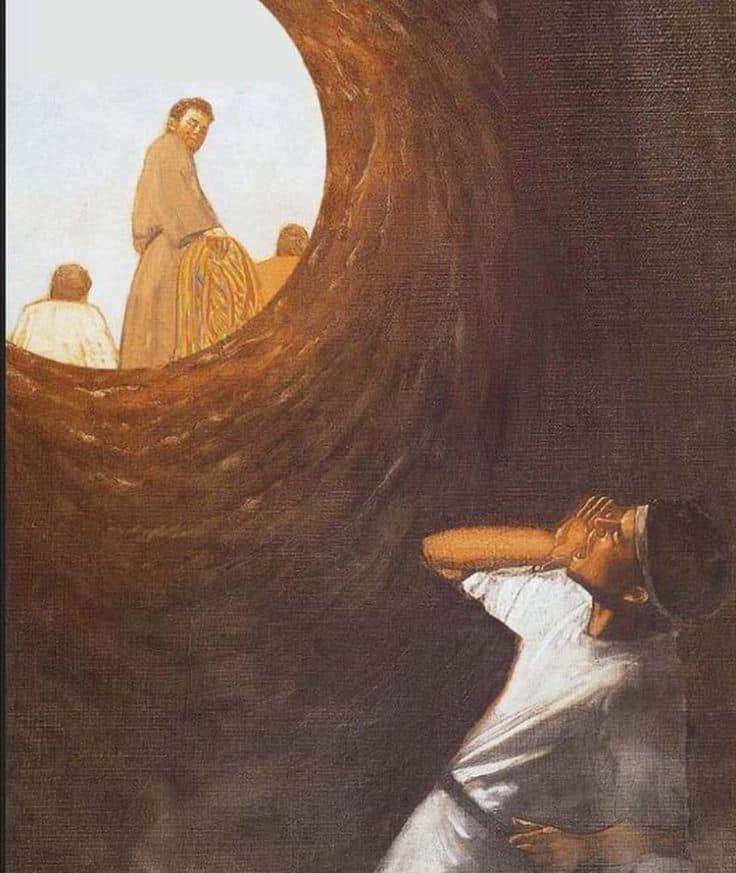
Thanks to whoever decided to pair this Gospel with the story of Joseph in the first reading, we get another angle to the seeming naïveté of the landlord father. In the first reading, the father is Jacob. The son who is being sent is to the field is Joseph. The people he is sending them to are not tenants, not strangers. They are his other sons too… It explains why he entrusted Joseph to them. He’s sending a younger son to his elder siblings. How could he have preempted that they were going to maltreat him or even plot to kill him? I am sure that if Jacob loved Joseph, he loved the rest of his children too. They couldn’t see it of course because they were blinded by their envy.
Parang teledrama ang kwento ni Joseph; masyado namang kontrabida ang datíng ng mga kapatid. Good thing we have a protective big brother image in Reuben who tries to save Joseph instead. It tones down the villain image of the brothers. They were normal people after all.
The story shows how God writes straight with crooked lines. The crooked plot is partly done; they don’t kill him but they put him in a cistern and later sell him as slave to travelers who are on their way to Egypt. There he would rise, against all odds, into a governor. The one they had maltreated would now be in power. The tables would turn on them. If this were a Sharon movie, it would have been entitled BUKAS LULUHOD ANG MGA TALA. But then comes the real twist: just when he has all the chances to avenge himself, Joseph decides instead to forgive his brothers. He will see the hand of God in everything that had happened.
Now you can reread the parable differently. Now you understand why the owner of the vineyard had said, “they will respect my son” because he treated the tenants as his own sons. His only mistake was his trust in their goodness of heart was greater than his distrust in their capacity for wickedness. He was wrong, of course. Now what should he do?
Jesus poses the question to his audience: what should the master do? And they quickly reply saying, “the wicked tenants should die.” They are naively hooked into answering, not realizing that they were the tenants in the story and they had just pronounced a death sentence on themselves. Iyun ang batong bumubukol!
Their perspective of strict justice ends up convicting them. But the Lord invites them to assume his perspective, the perspective of MERCY. From the chief priests’ strict point of view of justice, the tenants were doomed for their wickedness; they were beyond redemption and deserving only of condemnation. How could they have thought na sila pala iyung masamang katiwala sa talinghaga?
The Lord sticks to his perspective of mercy. These men are not evil. You may say they were blind, deluded, sick, but to call them evil is to comdemn also the Master who trusted them, or the Creator who created them.
The stone which the builders rejected… Siya ang bato, hindi batong patama kundi batong panulukan, the cornerstone that will save the whole structure, despite its unworthiness.
It is easy to take the perspective of the chief priests and scribes: to project God as a punishing God, a God who seems so eager to condemn sinners to hell. Jesus invites us to a different perspective. His power lies in his love and mercy, not his justice and judgment. Recall the psalm “IF YOU O LORD SHOULD MARK OUR GUILT, WHO CAN STAND?” (Ps 130:3)
What would he do when we cut ourselves off from him; when we damn ourselves to hell? He will play his last card: he will go down to hell, embrace the consequence of our wickedness, our suffering and death, to get us out of the hell we make of our lives.
What did Jesus do when his own friend judas betrayed him? Did he condemn him? No. He took the bread and offered the first eucharist to break the spell of evil that had possessed Judas. He will become the sacrificial lamb by whose blood the sinners will be forgiven.
Remember John 3:16? “For God so loved the world, he gave us his only Son…”
If our solution is just to condemn and exclude sinners, we have not learned the way of Jesus yet. He took the bread and the wine and offered it as his own body and blood for Judas and the potential Judases anyone of us can become. In his first Eucharist, he won against Satan by turning a meal of betrayal into a meal of forgiveness. The price was his own blood, no less. But it had the power of reversing the curse of sin and death.