

339 total reads
Old habits are indeed difficult to unlearn. And nowhere is this perhaps more evident than in the way our House of Representatives continues to deal with the national budget.
In 2013, the Supreme Court declared the congressional pork barrel system unconstitutional. In Belgica v. Ochoa, it ruled against personal lump-sum allocations that legislators could use to choose their own projects, as well as formal and informal arrangements allowing them to participate in implementing the budget.
Yet, more than a decade later, pork barrel politics appears to have survived, assuming different forms and finding new ways of entering the national budget.
Why is this old habit so difficult to break?
I suspect it has much to do with our deeply entrenched politics of patronage, reinforced by political dynasties. When public projects and assistance programs become associated with the generosity of politicians rather than the rights of citizens, public funds become powerful instruments for cultivating political loyalty.
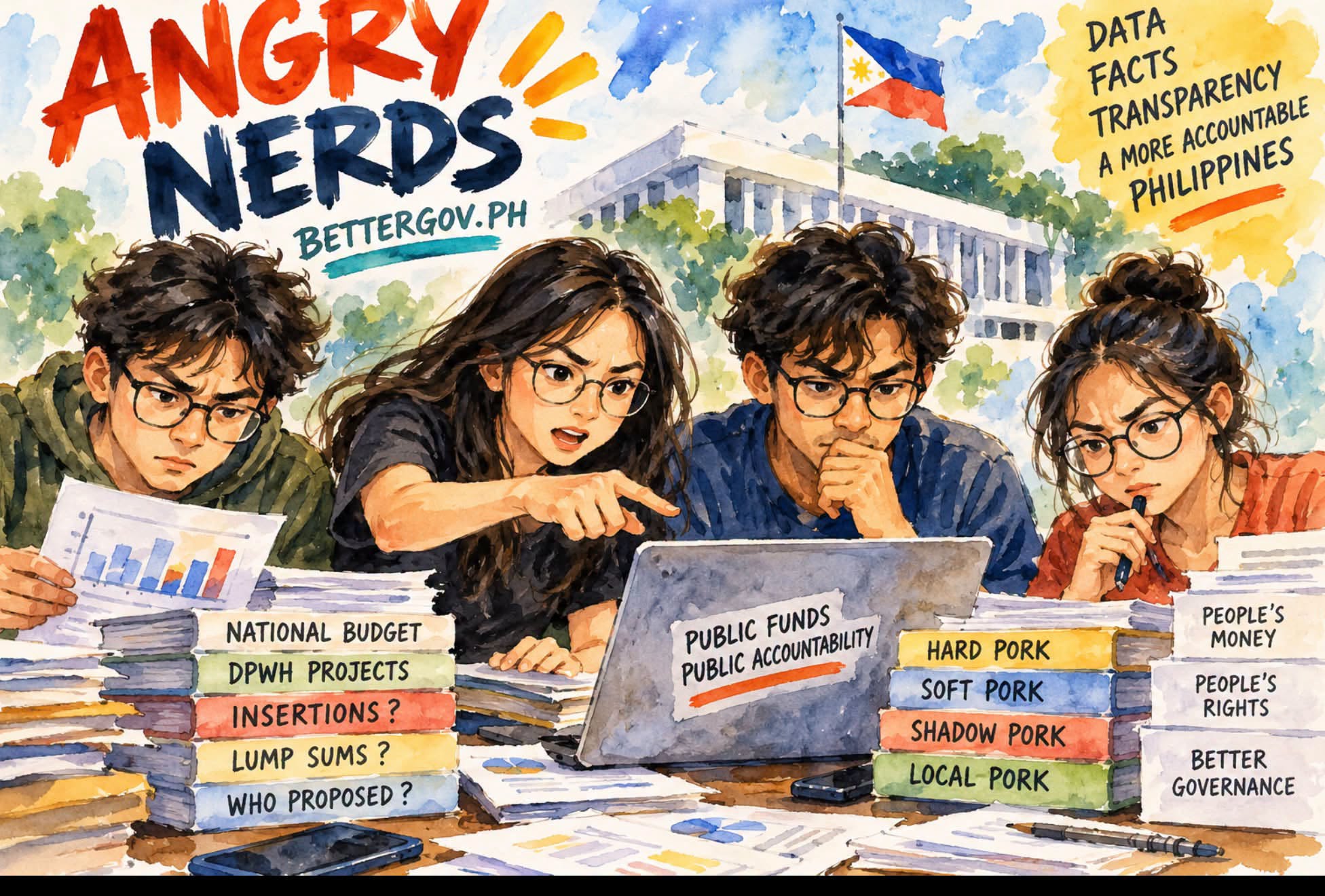
This is why I find the recent findings of the People’s Budget Coalition (PBC) and the young citizen budget-watchers of BetterGov.ph, popularly known as the “Angry Nerds,” particularly disturbing.
They have identified four categories of budget allocations vulnerable to political patronage:
1. HARD PORK — Infrastructure projects such as roads, bridges, flood control structures, and multipurpose buildings. These become vulnerable to abuse when projects are selected for political reasons rather than actual public need, or when their locations, costs, and specifications cannot be independently verified.
2. SOFT PORK — Social assistance programs, including medical, educational, and financial assistance. These are necessary programs, especially for the poor. But they become instruments of patronage when access to assistance depends on politicians’ referrals, recommendations, or endorsements, making citizens feel indebted to politicians for benefits funded by their own taxes.
3. SHADOW PORK — Funds hidden, so to speak, in less transparent budget mechanisms, particularly unprogrammed appropriations or standby funds. These may be legitimate when properly authorized and safeguarded, but they become vulnerable to abuse when their purposes and conditions for release are vague.
4. LOCAL PORK — Funds distributed to local governments through mechanisms such as the Local Government Support Fund. These can support genuine local development, but become susceptible to patronage when allocations are influenced by political connections rather than transparent and equitable criteria.
These are categories of risk identified by budget watchdogs, not proof that every project or program is corrupt.
According to PBC’s preliminary analysis of the House-approved 2027 budget, nearly 7,000 infrastructure projects worth approximately ₱190 billion were added without publicly available supporting project documents. Around ₱172 billion of these additions involved nearly 6,200 DPWH projects.
The House leadership objects to calling these additions “insertions.” They insist that Congress has the constitutional power to introduce amendments to the President’s National Expenditure Program.
Of course it does! Nobody is questioning Congress’s power to scrutinize and amend the proposed budget.
But the power of the purse is not an unlimited power to distribute public funds according to political discretion.
The Constitution gives the President the responsibility to prepare and submit the national budget, Congress the responsibility to deliberate and authorize appropriations, and the Executive the responsibility to implement the approved budget.
In Belgica v. Ochoa, the Supreme Court made clear that legislators cannot be given personal discretionary allocations or exercise executive powers over the implementation of projects. It even prohibited informal arrangements that have substantially the same effect.
And just this October, the Supreme Court again emphasized constitutional limits on congressional budget powers, ruling against increases in appropriations that exceeded the President’s recommended total and invalidating certain provisions governing unprogrammed funds.
These rulings do not mean that every congressional amendment or lump-sum appropriation is unconstitutional. But they remind us that the power to amend is subject to constitutional safeguards.
This is why the PBC findings demand serious examination.
Were these additional projects independently evaluated by the implementing agencies? Who proposed them? What needs assessments and cost estimates justify them? Were legislators effectively given predetermined allocations to distribute among their districts?
And if so, how different would that be, in substance, from the old pork barrel arrangements that the Supreme Court already prohibited?
I am not suggesting that every congressional amendment is corrupt. Many communities genuinely need roads, schools, hospitals, irrigation systems, and social assistance. But precisely because these needs are real, they should never become instruments of political patronage.
The Senate now has an opportunity—and a responsibility—to demand full disclosure of the proponents, locations, technical specifications, costs, and justifications of the House-added projects. Those that cannot be adequately justified should be removed. If questionable items survive Congress, the President must seriously consider exercising his constitutional veto power.
The Executive, too, must explain whether its own agencies have technically evaluated these additions. It cannot simply defend them on the assumption that they might benefit the public.
Above all, we need to dismantle the culture of patronage that keeps resurrecting pork barrel politics under different names.
Public funds are not the personal generosity of politicians. They are the people’s money, entrusted to public officials for the common good.
Perhaps this is the old habit we most urgently need to unlearn: treating public office as a means of dispensing favors, instead of a responsibility to serve citizens fairly.
I am grateful to the People’s Budget Coalition and the “Angry Nerds” for helping us see what is happening to our national budget. Their work reminds us that democracy requires more than elections. It requires informed citizens who continue to watch over how their government exercises power.
As they remind us:
“Buwis natin ’to. Boto natin ’to. Budget natin ’to.”
It is time to unlearn the politics of patronage—and relearn the politics of public service.