

13,749 total reads
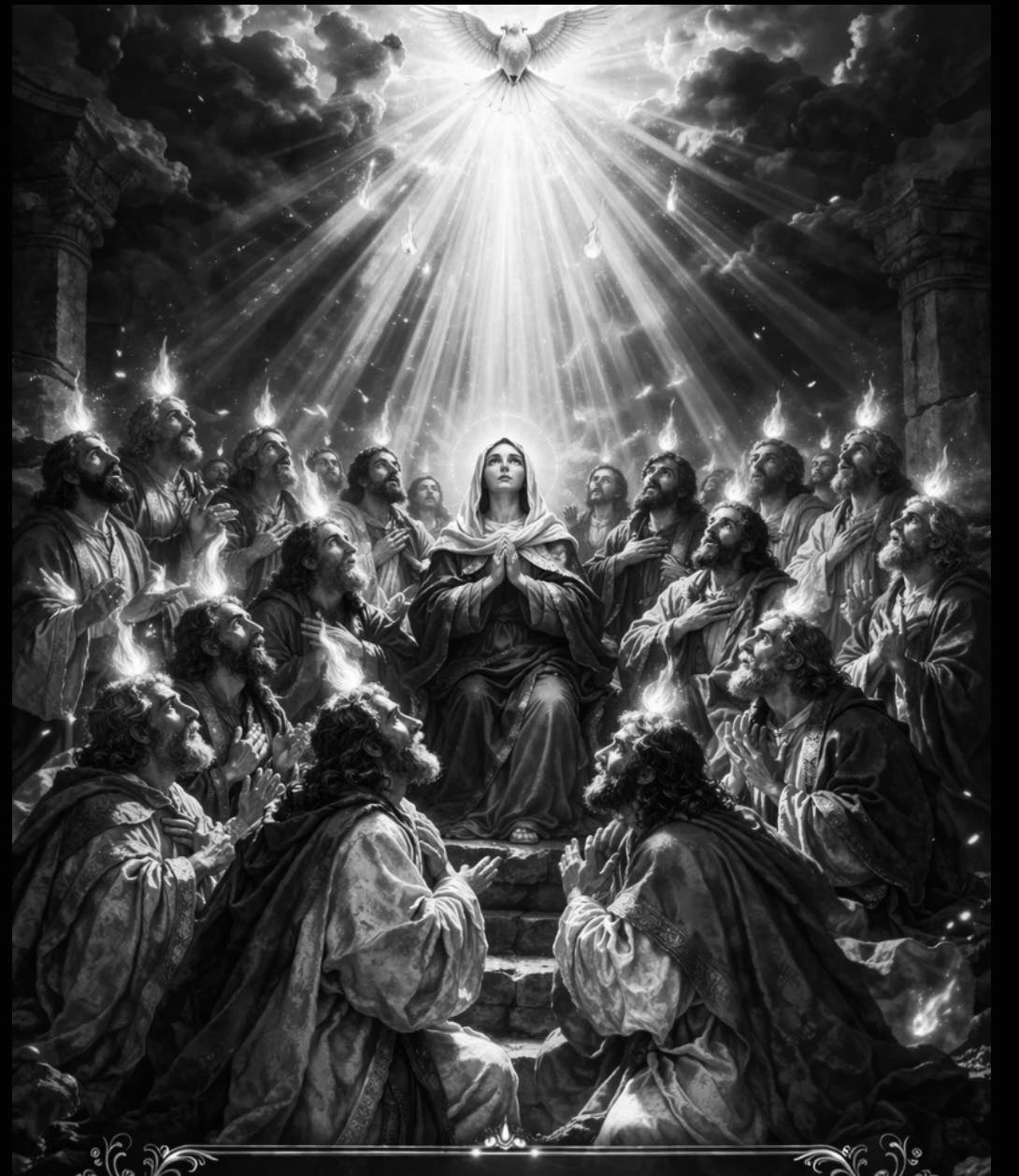
Pentecost Sunday
Acts 2:1–11
The narrative highlights the Spirit’s descent, emphasizing its theological significance over literal history. Pentecost, held fifty days after Passover, likely featured the giving of the law on Sinai, symbolizing the new law of the Spirit replacing Mosaic legislation. The narrative connects phenomena like noise and fire with Sinai. The gift of tongues initially may have been ecstatic speech but is understood here as languages, emphasizing universalism and reversing Babel’s confusion. The rapid transition from the upper room to public proclamation showcases the Spirit’s movement towards outreach to all nations, with apostles addressing a diverse audience and highlighting Jesus’ salvific acts.
1 Cor 12:3-7, 12-13
Paul emphasizes the diversity of the Spirit’s work among believers. He warns against false spirits and highlights criteria for authentic Spirit within the church, noting the Spirit will not label true as false. Using baptismal confession as an example, he affirms that professing Jesus as Lord is Spirit-led. The Spirit’s manifestations include gifts, service, and divine works—all interconnected and for the common good, not individual gain. These are expressions of God: the Spirit, Christ, and God, foreshadowing the Trinity. The gifts are for shared purpose, not personal. Paul likens the church to a body, with unity in diversity, unified by the Spirit regardless of background, as all are baptized into one Spirit.
Jn 20:19-23
The gospel describes Jesus’ first post-resurrection appearance to his disciples, emphasizing his glorified state, the conferral of the Spirit, and the themes of peace and forgiveness. Unlike Luke, John focuses on this single transcendent event, blending appearances, ascension, and Pentecost. The Spirit’s gift restores harmony and grants the authority to forgive sins, symbolized by Jesus breathing the Spirit into the disciples, echoing God’s breath in creation. It addresses early believers who rely on God’s Spirit rather than direct contact, praising faith rooted in Spirit action.
The Pentecost celebration reminds us of new life. The Holy Spirit transformed fearful disciples into the Body of Christ, breathing a new understanding and becoming a new creation. We celebrate today, the Church’s birthday, which happens to each of us when baptized, confirmed, forgiven, and reconciled. Like the disciples, we receive a mission and empowerment through our gifts to continue Jesus’ work, build God’s kingdom, and bring peace on earth, guided by the Holy Spirit. Amen!
s1S#139 Wind
The “temporal” narrative of the descent of the Holy Spirit (so with the Ascension of the Lord before that) is found only in St. Luke’s Acts of the Apostles (2:1-11, today’s second reading), recounting ‘a strong driving wind coming from the sky filling the entire house where the first Christian community was gathered’, (vv1-4). It was the Jewish feast of the Pentecost, (for its origin, history, and development, (cf s1S#32, 5/23/21).
Etymologically the noun “pnoē“ (πνοή) is related to the Hebrew word “ruah”, the Greek “pneuma” and the Latin “spiritus” which basically means “wind”, “air in motion”, “breath”. The root meaning is power. Apart from human and animal power, wind was the main observable energy source in the ancient world. It was experienced as a cool, refreshing breeze (Gen 3:8), as a strong wind (Ex 10:13,19), and as a hurricane or tornado (1 Kgs 19:11). As with water and fire, the wind in ancient understanding has the property that allows it to be “be poured out”, as in the pouring out of the spirit of God (cf Ez 39:29; Is 32:15; Joel 3:1f). And since our ancestors in the faith perceive and understand God from a human perspective, He is shown acting in human life through his vital power or spirit, his breath, which he “sent, placed or poured”, (cf Is 48:16, 63:11).
In the NT this divine power becomes personified. Sent by the Father and “breathed on” by the Son (John 20:22; cf s1S#88, 5/06/22), this act of the risen Jesus imitates the moment of creation when God “blew” up the nostrils of Adam and brought him to life (Gen 2:7), thus recreating these human beings as children of God. While In Lk tongues of fire appeared after the strong wind, (Acts 2:3-4), reminding them of the fire which he brought on earth and wished it is already blazing (Lk 12:49).
As we celebrate the coming of the Holy Spirit we thank God for the gift of new life not only for us individually but also for the birth of the Church, the body of Christ to which we all belong to. And with fire enkindled in our hearts, may it embolden us to proclaim his gospel of forgiveness and love not necessarily in tongues but by our Spirit-filled lives. Amen.