

16,411 total reads
22nd Sunday A
Jer 20:7-9
Jeremiah’s book mainly features his oracles about Jerusalem’s final days before exile, along with personal reflections on his demanding calling. Today’s reading is from these ‘confessions,’ showcasing a daring conversation with Yahweh. After predictions of Jerusalem’s destruction, Jeremiah, punished publicly, addresses Yahweh with provocative language, likening God’s influence to seduction and seizure, highlighting his pain and frustration. Despite his original mission to build and plant, Jeremiah faces rejection, hostility, and physical abuse. In verse 9, he compares God’s word to a fire that must be spoken, driven by divine necessity. This underscores the strong divine direction in prophecy—once called, there’s no turning back.
Rom 12:1-2
The reading emphasizes identification with God’s will through sacrificial imagery. Paul likens believers to living temple sacrifices, contrasting traditional dead offerings with Christians offering worship “in the spirit,’ empowered by Christ. This imagery highlights total self-surrender and ongoing transformation by the Spirit, involving continuous disengagement from the passing world and renewal of the mind as God’s will becomes central.
Mt 16:21-27
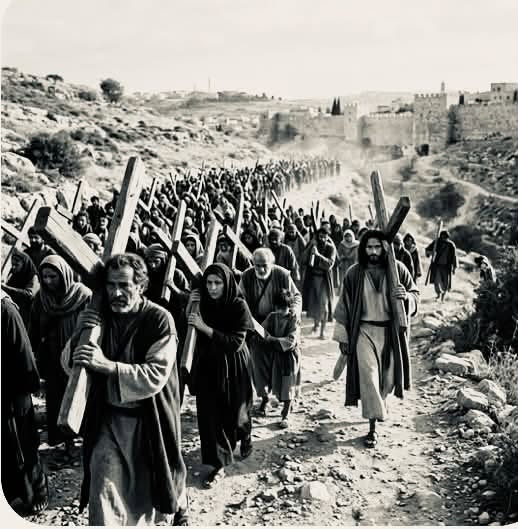
This passage marks a crucial turning point in Matthew’s gospel, shifting from glory to the cross after Peter’s declaration of Jesus as Messiah and God’s Son (cf. last Sunday’s gospel). Jesus now discusses the implications of his identity, immediately pointing to the darker side of the Servant role: his upcoming suffering, death, and resurrection. The prediction of his passion highlights the necessity of this death and resurrection.
The word “dei” (δεῖ) is an impersonal verb in the indicative mood, which can be translated as “it is necessary that…” or “must,” “should,” or “ought,” (cf s1S#67 I Must, 01/16/22), followed by the main verb, here “to suffer” (‘paschō,’ πάσχω), meaning “to endure suffering, both physical and psychological” (cf s1S#131 Suffer, 04/03/23). So, v 21 literally reads, “it is necessary that he… suffer…” emphasizing Jesus’ engagement with God’s will and predicting his suffering and resurrection (vv. 21-23). This also applies to those who follow him. Peter’s attempt to dissuade Jesus and his rebuke highlight the contrast between human and divine reasoning, fitting into the theme of glory and suffering. The verses on discipleship (vv. 24-28) stress the importance of carrying the cross and self-denial, with inverted values: human loss leads to Christian salvation, and sacrifice is necessary for eternal rewards when Christ returns.
The message of today’s scriptures centers on the unconditional “yes” to the will of God. Jeremiah accepted his God-given mission despite it being difficult, even though he was strongly tempted to turn away. Jesus refuses to let any voice, from any source, pull him from his divine destiny. Even though it leads him through the valley of death, he unwaveringly follows the path his Father has set before him. This kind of “living sacrifice,” as Paul describes, is what we are called to offer to God. May we all be able to say our unconditional yes to the will of God. Amen