


5,004 total reads
25th Sunday A
Isaiah 55:6–9
The reading talks about seeking the Lord, traditionally through temple worship, but later influences, especially from Jeremiah and Ezekiel, emphasize seeking God within the heart, beyond fixed places or times. Dispersed people realized their relationship with Yahweh remained strong, written on their hearts, not dependent on a temple. To find the Lord, sinners need only turn to Him and away from sin, trusting in His limitless mercy. Divine transcendence means God’s nature is beyond full human understanding.
Phil 1:20-24, 27:
Paul, likely in Rome, reflects on his future while imprisoned. His baptism means he lives in Christ, regardless of life or death (v20). The “body” signifies the person, not just physical parts. His life in Christ is his ‘all” (Gal 2:19f). If sentenced to death, he sees it as gain, as it brings closer union with Christ; if acquitted, he can do more missionary work (vv20-21). Both outcomes are blessings; he struggles to choose.
Dying would be his ultimate goal (v23), with theological ties to bodily resurrection (1 Thes 4:13-17; 1 Cor 15:53f), though he says little about the state between death and resurrection. The focus is on ongoing union with Christ.
Paul is willing to set aside personal desires for his mission’s sake and encourages the Philippians to live according to their faith (v25, 27).
Mt 20:1-16
This parable is again to unique to Matthew. Though bracketed by the saying of Jesus on the reversal of fortune in the reign of God (19:30 and 20:16), in itself it may be referring to the equality of everyone to be admitted into the kingdom of God and the reward of inheriting eternal life regardless of their background.
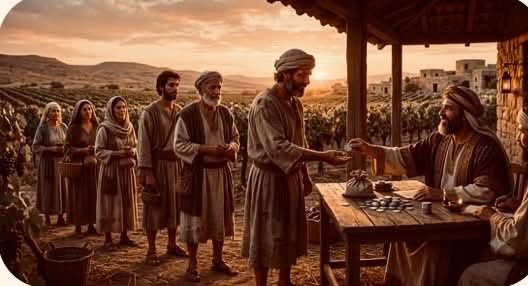
The parable contains two major parts: the hiring of the workers (20:1-7), and the paying of the workers (20:8-15). In the first part (20:1-7) the landowner goes out to hire laborers for his vineyard. He meets with and hires five different groups throughout the day: at dawn (vv1-2), at the third hour (9 am, vv3-4), the sixth and ninth hours (noon and 3 pm, v5), and the eleventh hour, 6 pm, 20:6-7). The second part (vv8-15) takes place at the vineyard. It consists of the payment (vv8-10), the protest by the first workers hired (vv11-12), and the response by the owner(vv13-15).
The owner’s defense of his action used the word “adikeō” (ἀδικἑω) and it is rendered as, “not cheating”, or literally, “not treating unjustly or being unfair, and doing no wrong”. He commits no injustice, indeed (vv4, 13)! That all the workers receive the same wage is due only to his kindness or generosity, (literally, he is good v16), to the latest arrivals. Thus, in his rhetorical question to the first group he hinted at their “opthalmos poneros” ὀφθαλμός πονηρός, (literally, “evil eye” v15, evil as basically opposed to good). It is understood as being envious or jealous (cf Mk 7.22). It is from envy where the resentment of the first group comes from. Furthermore, the parable defends Jesus’ special concern for the marginal in Jewish society (”tax collectors and sinners” Mt 11:19). A recurring complaint against his ministry was his association with disreputable people, an association that he never denied, for he “came not to call the righteous, but sinners” (Mt 9:13). This may reflect also later tensions within early Christianity between Jewish and Gentile believers. The point is that in the kingdom, the blessings and rewards are received out of the goodness and love of God and not based on merit or entitlement nor length of service. In the kingdom, there is no room for envy or greed.
With its vineyard and harvest symbolism, the parable is concerned as well with the last judgment. The grumbling is focused on why the latecomers receive the same reward as those who came earlier to work. The answer is that the kingdom is God’s gift to give and no one can begrudge his generosity.
Indeed, “My thoughts are not your thoughts,” says the Lord (cf. First Reading Is 55:6-9). God’s way of acting does not follow human standards or predetermined paths. Yet, we are all recipients of God’s limitless generosity and mercy. We cannot help but be grateful by aligning our ways more with His, going beyond the ordinary, the normal, the expected. Amen.