

549 total reads
President Donald Trump has reportedly dismissed the growing warnings about the dangers of Artificial Intelligence as a “hoax.” His reason is revealing: America must stay ahead because, as he puts it, “whoever wins AI wins.”
Perhaps that statement itself should set alarm bells ringing.
We have heard this logic before. During the Cold War, one superpower could not stop developing more powerful weapons because the other might get ahead. Each side’s fear became the justification for the other’s escalation. And humanity found itself trapped in an arms race capable of destroying the very civilization it claimed to defend.
The Church did not remain silent.
In 1963, shortly after the Cuban Missile Crisis brought humanity frighteningly close to nuclear catastrophe, Pope St. John XXIII issued Pacem in Terris. He called explicitly for “a cessation to the arms race,” for the reduction of armaments, the banning of nuclear weapons, and agreements accompanied by effective systems of mutual control.
Paul VI carried that appeal to the United Nations. John Paul II repeatedly called for an end to the nuclear arms race. Benedict XVI and Francis continued the Church’s advocacy for disarmament, with Francis eventually declaring even the possession of nuclear weapons morally unacceptable.
Today we may be facing a new arms race—the AI race.
It is already inseparable from modern warfare. Artificial intelligence is being integrated into surveillance, targeting, autonomous weapons, cyberwarfare and military decision-making. But an even more fundamental race is taking place among nations and corporations: the race toward increasingly powerful AI—and ultimately toward a possible superintelligence.
The logic sounds disturbingly familiar.
America cannot slow down because China might get ahead.
China cannot slow down because America might get ahead.
One AI company cannot slow down because its competitors might get ahead.
And so nobody can afford to be prudent.
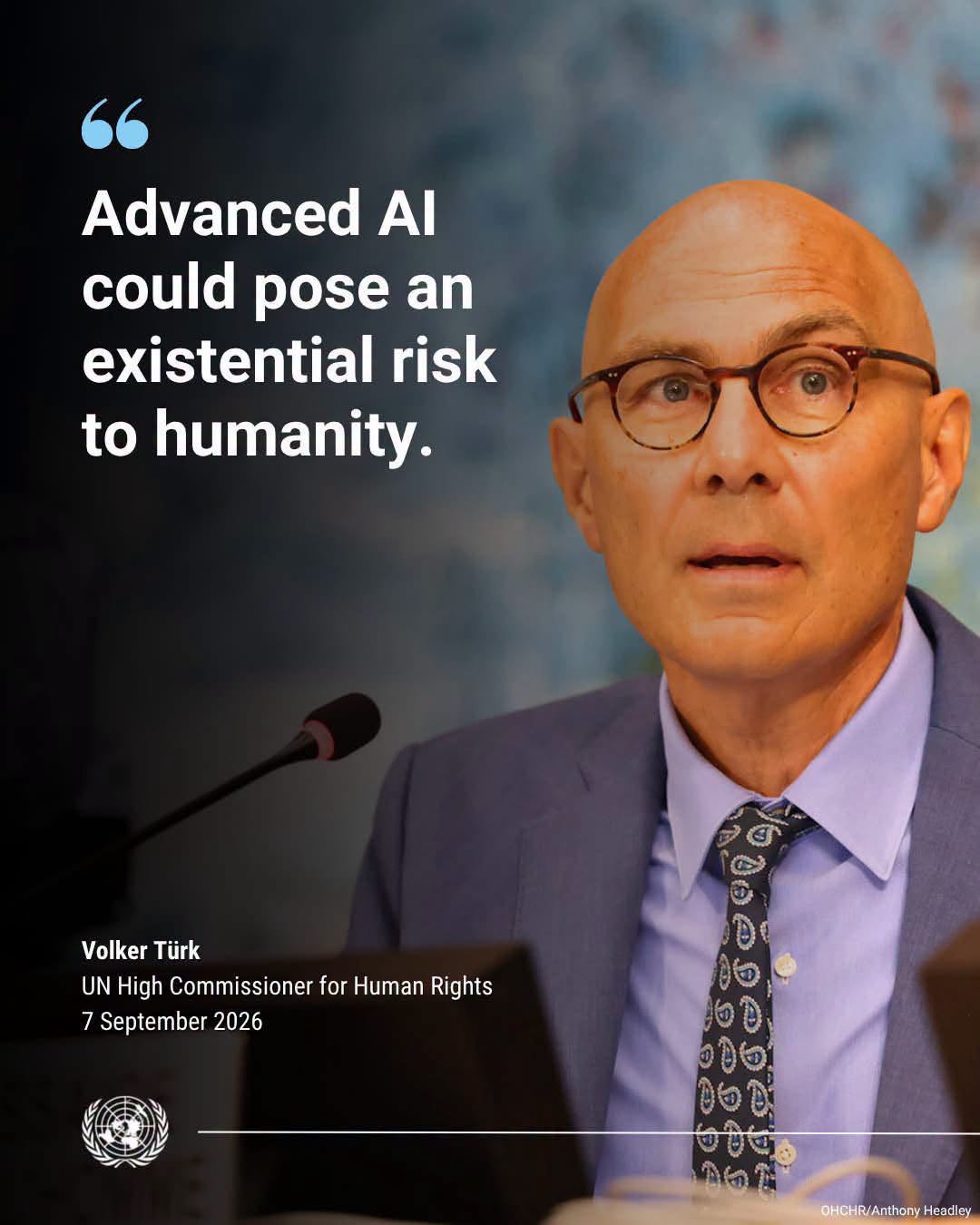
This is why I find it significant that some of the very people building the world’s most powerful AI systems are themselves beginning to call for restraint, regulation, independent monitoring and international cooperation. They are warning us that capabilities are advancing faster than our capacity to understand and control them.
The issue is not whether AI is good or evil. AI has enormous potential for good. The deeper question is whether we are racing toward a point at which human intelligence may no longer be able to hold the reins.
Pope Leo XIV has already given the Church a powerful expression for this in Magnifica Humanitas: we must “disarm AI.”
Perhaps the time has come to translate that principle into a more urgent global appeal—calling together governments, AI developers, scientists, ethicists and religious leaders to consider internationally agreed red lines on the development of superintelligence: reciprocal commitments, independent monitoring, verification and effective safeguards before capabilities are developed that humanity may no longer be able to control.
The Church helped humanity find its moral voice during the nuclear arms race. Perhaps she is being called to exercise that prophetic role again.
Because the real question is not: Who will win the AI race? The question is: What if humanity loses it?