Homily for the Feast of the Immaculate Conception, December 8, 2025 – Luke 1:26–38
To explain why we refer to Mary by the title Our Lady of the Immaculate Conception (meaning “free from every stain of sin” from the first moment she was conceived in the womb of St. Anne), we actually have to begin with Jesus Christ, the Son of God who was born from her womb.
You probably know that Pope Leo XIV has just concluded his visit to Turkey. There, he joined in commemorating a major moment in the history of our Christian faith: the 1,700th anniversary of the Council of Nicaea held in 325 AD. The Pope couldn’t even set foot there because the ancient city—now called Iznik—has sunk below sea level; it’s literally underwater. (Something that could also happen one day to Malabon and Navotas because of climate change and flood control projects that fail due to corruption! That’s why in the images we saw of the commemoration, Pope Leo ang Patriarch Bartholomew were on a boat, gazing from a distance at what used to be the city of Nicaea.)
It was in Nicaea that a more detailed creed was formulated—more detailed than the Apostles’ Creed—the Nicene Creed, which resolved a major doctrinal controversy about Jesus that had been stirred up by a priest from Alexandria in Egypt—Arius. Arius was so popular he even succeeded for a while in convincing some bishops of his teaching. According to him, Jesus Christ is a mere creature of God like us. And if He is created like us, He is not immortal. And if He is mortal, then He cannot be God who is immortal. The Christians of that time were divided.
But the bishops who gathered for the Council in Nicaea held firmly to the Church’s faith about Christ. Especially this line:
“God from God,
Light from Light,
True God from true God,
begotten, not made,
consubstantial with the Father;
through Him all things were made.”
Now, what does all this have to do with Mary? A lot!
The debate was this: If Jesus came from Mary’s womb—a human like us—meaning He inherited the brokenness of Adam and Eve, then how could He save humanity from sin?
For me, this is one of the most radical teachings of the Church: Sinfulness is not our original nature. We were created good, by nature. God’s original plan is that the human being should reflect His own holiness and fullness. Thus He created us in his image and likeness. He endowed us with dignity and intended us to share in His eternal life.
But because God is LOVE, and because someone who is made in God’s image cannot truly love unless they are also free, He gave us free will. In a way, God “took the risk” of giving humanity freedom—and the devil, in his envy, took advantage of that. Satan wanted to prove to God that he was far more noble than human beings. So he made it his mission to drag humanity down—to tempt and seduce us into wanting to “be like God.”
Satan thought he had already won.
What he didn’t know was that God was not done yet with His work.
How would God redeem the humanity that Satan had corrupted?
By the Incarnation—the Word becoming flesh in Jesus Christ.
But for God’s plan to unfold, He prepared a New Eve.
Not an Eve who could be deceived by the serpent, but an Eve who was immaculate—
free from every stain of sin,
fully transparent to God’s grace,
and fully capable of a free but consistently faithful Yes.
A woman whose heart was so pure that the lies of Satan would not penetrate it.
A woman full of grace.
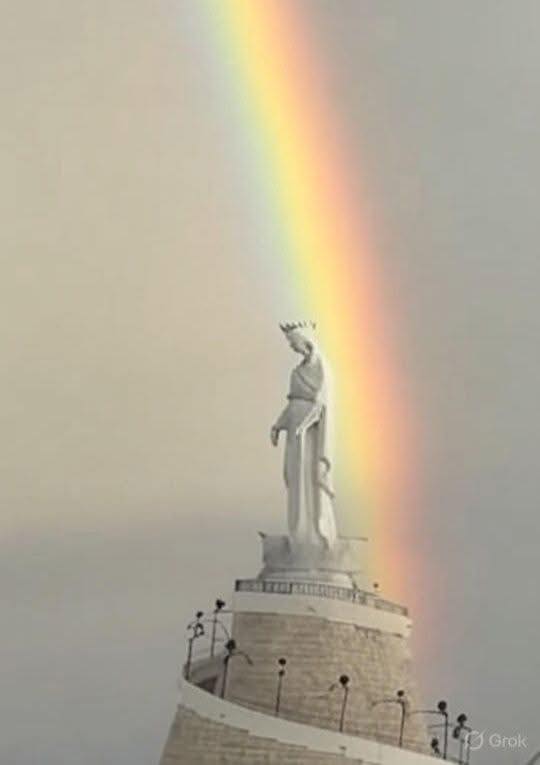
This is why in the icons of the Immaculate Conception, Mary is shown crushing the head of the serpent. She is silencing the deceiver. The message is:
“Your lies will not work on me.”
This is why she is called Mother of God.
She is the Mother of the Son of God who took flesh in her womb—so that through Him, God’s original plan for humanity would be fulfilled. And through our union with Christ, humanity’s dignity as God’s children would be restored—our nature once more reflecting the image of the God who is eternal.
Jesus, Son of God and Son of Mary, is the hope of humanity—the One through whom God’s plan for us is accomplished. And through our openness to the Holy Spirit—the Spirit of the Father and the Son—the dignity of being children of God shines in us, children also of Mary, the one who is without stain, without shadow of sin, full of grace.