

12,355 total reads
18th Sunday C
Is 55:1-3
The reading describes how returning to Jerusalem highlights a shift from traditional kingship and Sinai covenant to a new theocratic state. Second Isaiah stresses God’s active role through a new covenant (Jer 31:31-34), featuring a wisdom motif. It invites the restored people to wholeheartedly turn to Yahweh (v1), echoing Lady Wisdom’s call, attracting those seeking understanding and forsaking folly (Prov 9:4ff; Sir 24:18ff). Yahweh addresses the poor, requiring only an open spirit, warning against deception and inauthenticity (v2). The everlasting covenant (v3) surpasses Sinai, recalling Noah and Abraham, symbolizing a renewed divine relationship that prioritizes direct, personal contact with Yahweh, less reliant on Sinai or Davidic covenants.
Rom 8:35, 37-39
Paul concludes the section where he discusses the law, freedom in Christ, and life in the Spirit (chaps. 6-8). He sees nothing in creation that can separate believers from God’s love, expressed through Christ’s death and resurrection. No accuser, distress, or supernatural power can sever this love communicated by God’s Spirit. Paul mentions the hardships of the Christian mission, which he endured (v35; 2 Cor 4:8f; 11:23-28). Christians triumph over adversity through Christ’s power (v37), unshaken by cosmic forces—angels or principalities (v38), celestial beings influencing the universe. Present and future things (v38), possibly astrological influences, and height and depth (v39), related to planetary effects, are also referenced. Paul celebrates God’s love as invincible, bringing the elect from death to life amid natural and supernatural forces.
Mt 14:13-21
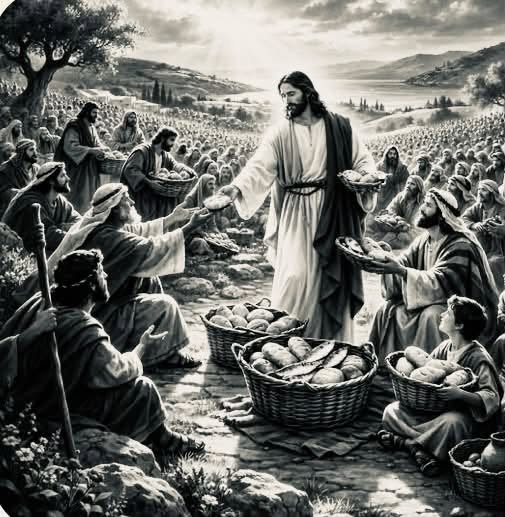
The gospel highlights the similarities in the loaves and fish story across the gospels, focusing on differences from John in Matthew. Jesus withdraws after hearing of John’s death, showing sorrow and compassion, which leads to healing rather than teaching as in Mark. The story echoes the Exodus and Elisha’s feeding, emphasizing sacramental language with Jesus centering on the bread, with fish losing significance. Matthew stresses the disciples’ ministerial role—bringing the crowd, offering the loaves and fish, and distributing bread—illustrating the eucharist’s apostolic service. The abundance of bread underscores divine generosity, with Matthew uniquely mentioning women and children, emphasizing divine largesse.
“The hand of the Lord feeds us; he answers all our needs,” (Ps 145:16). This responsorial psalm captures the essence of today’s liturgical celebration. Second Isaiah assures the returning exiles that if Yahweh truly reigns supreme in their lives, their hopes will be fulfilled, and their needs will be met. The Matthean account of the loaves depicts Jesus in a desert setting, surrounded by a hungry crowd. His generous response to their physical hunger serves as a powerful metaphor for the Eucharist, where the Lord continues to nourish His people. St. Paul concludes the eighth chapter of Romans with an enthusiastic hymn of praise for Christ, who has shown unwavering love for us. This love surpasses any obstacle that may arise between the lover and the beloved. Indeed, God cares for us deeply, for nothing can separate us from Him. May we all share in the responsibility of caring for everyone as God did. Amen.