


6,901 total reads
All Saints Day
Rev 7:2–4, 9–14
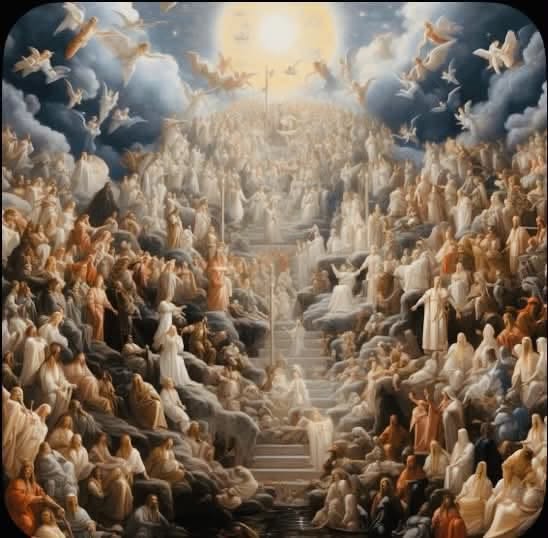
The elect stand before God on the throne and Christ, the Lamb, having achieved final salvation. The great multitude represents the reconstituted Israel of the new covenant, its completeness symbolized by twelve tribes multiplied by one thousand: 144,000 (v. 4). The four angels restrain destruction of earthly elements, allowing time for God’s signet to seal the elect as his own.
The same crowd is then seen from another perspective (v. 9): people of every nation, the new Israel of Gentiles and Jews. Their white robes symbolize baptismal purity through Christ’s redemption and the faith of those who suffered persecution (vv. 13–14); clothing expresses inner qualities. Palm branches symbolize final triumph.
In their hymn (v. 10), the elect credit salvation (Greek: *soteria*) to God and Christ, the Lamb. Early Christian doctrine is often reflected in liturgy, especially hymns; the equal worship offered to the Father and Jesus shows their equality. Around the throne stand angels, the twenty-four elders—representing the twelve tribes and twelve apostles (4:4)—and four living creatures. Originally guardians of pagan temples, these mythological figures became part of Israel’s heavenly court (Ezek. 1:5–21).
The scene concludes with the heavenly host praising God for what he has accomplished.
1 Jn 3:1–3
Children (v. 1), an affectionate term in the Johannine community (2:1; 2:18; 2:28; Jn 21:5), reflects the new relationship with Christ that makes believers members of God’s family, like Paul’s “sons of God.” “We may be called” and “we are”—the latter emphasized in Greek—show this is more than a figurative title.
The passage makes three points. First, the world’s failure to recognize Christians’ new relationship with God should not surprise them: it failed to recognize Christ too (v. 1; Jn 15:18f; 17:14ff). Here, “world” means the realm of evil, not the object of God’s love (Jn 3:16). Second, God’s love, which is the Spirit’s life, pledges the glory to come (v. 2). This theme of new life beginning now and continuing into eternal life recurs in John (Jn 4:14; 6:40). As Christ is the “firstborn of the dead” (Col 1:18), believers will be transformed as he was. That transformation has already begun through seeing God in Jesus (2 Cor 3:18). Third, their hope and conformity to Christ call Christians to live out Jesus’ virtues (v. 3; 2:29).
Mt 5:1–12
Matthew’s Beatitudes differ from Luke’s. Luke’s poor, hungry, and mourners represent mainly socio-economic groups for whom the Messiah has special concern (Is 61:1–4). Matthew gives these categories a spiritual dimension, presenting them as expressions of the anawim.
The poor, mourners, and meek lack human comfort and support, relying on Yahweh for deliverance. Matthew’s “poor in spirit” emphasizes the humility and lowliness associated with poverty (v3). Mourners grieve as evil seems to prevail (v4), while the meek endure with patience (v5; Ps 37:11).
Luke’s hungry become those who “hunger for justice”—those longing for God’s reign to be fully established (v6). The merciful forgive (Mt 6:12–14) and love their neighbors (v7; 5:44–47). “Purity of heart” means spiritual transparency and sincere covenant fidelity (v8). Peacemakers restore harmony among individuals and communities (v9). The final Beatitudes (vv10ff) reflect the early church’s experience of persecution and hatred. Matthew’s contribution is especially clear here. Followers rejoice in adversity because they share the prophets’ fate and know their suffering will ultimately lead to the joy of God’s reign.
All the Beatitudes address the disadvantaged as they face the present world, assuring them of a better future. Though the first explicitly names the anawim, every Matthean Beatitude expresses authentic poverty and dependence on God, grounded in trust that Yahweh will ultimately vindicate them.
Today’s feast honors those who’ve entered heaven. It’s between the heavenly court of the saved and the earthly realm of the baptized. Revelation shows countless people from every nation standing before God and the Lamb, singing “Amen” as God’s saved. John reminds us we’re close to becoming God’s children.
Though the future is uncertain, it’s worth preparing for. The gospel paradoxically places those on the fringes of this life in God’s reign. May we become like them so that one day we can join that heavenly company. Amen!